
Microfabricated immune-isolating devices for long term cell based therapies
Suman Bose, Robert Langer and Daniel Anderson
Koch Institute of Integrative Cancer Research,
Massachusetts Institute of Technology, Cambridge MA 02139.
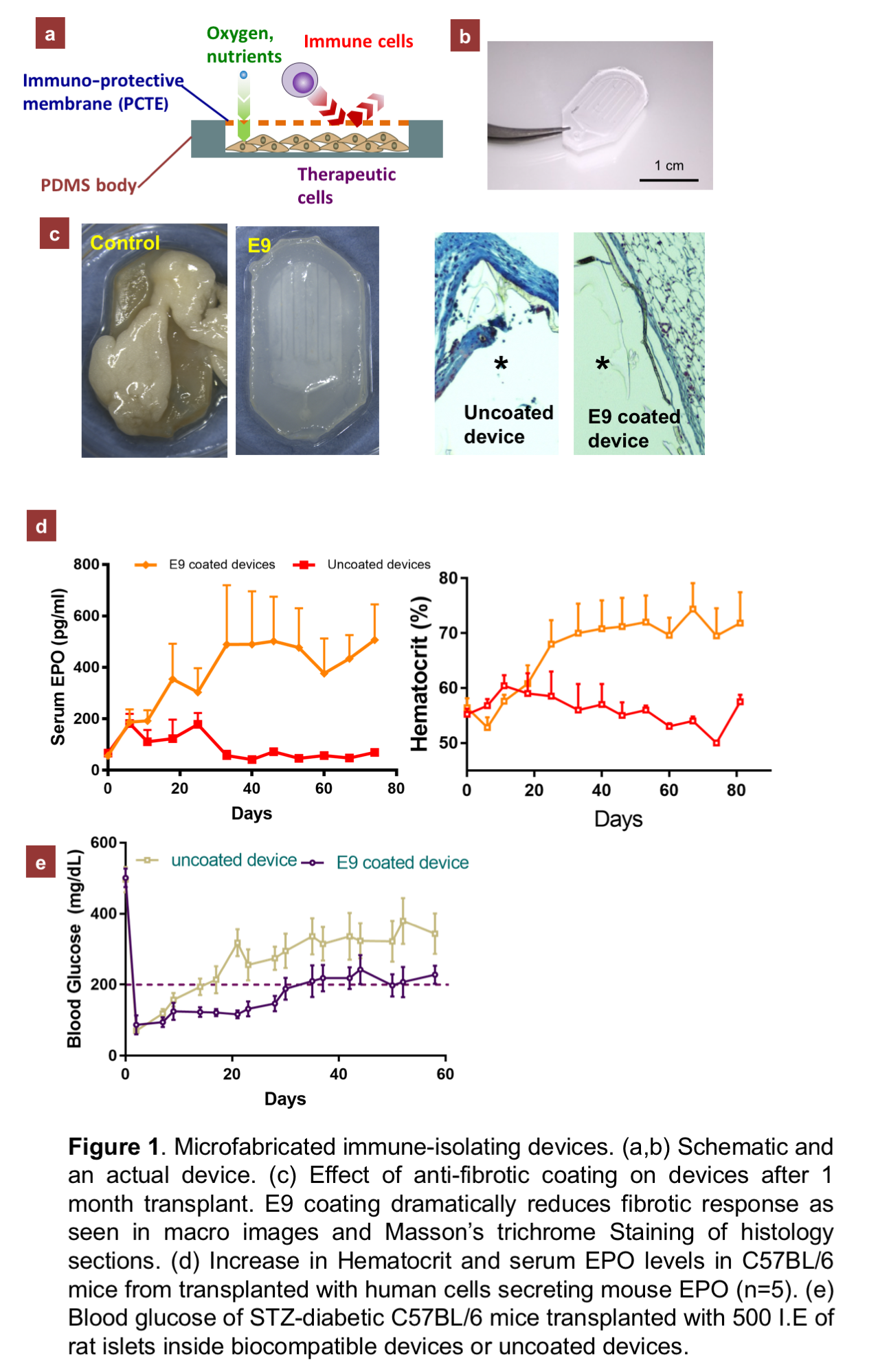
Introduction: Cell based therapies has the potential to treat a variety of chronic disease including type 1 diabetes, anemia, liver failure and Parkinson disease 1. Transplanting engineered or stem cell derived cells that secrete therapeutic factors for long periods of time have been an enduring goal. Implanted cells are often immunogenic, and in absence of immune-suppression are rapidly rejected by the host immune system. Cell encapsulation provides a safer alternative to immunosuppression for implanting foreign cells in vivo2,3. In this work we develop a microfabricated cell-encapsulating device having optimized geometry and pore-size, which protects the xenograft from immune cells while providing an optimal environment for their survival and growth. Through screening various biocompatible molecules, we develop a unique surface coating that results in dramatic reduction in foreign body reaction and fibrotic over growth on these devices. These devices could maintain engineered human cell lines secreting erythropoietin (EPO), in C57BL/6 mice for over 60 days. Rat islets implanted in these biocompatible devices restored normoglycaemia in STZ-diabetic mice for over 30 days.
Methods: Microfabricated PDMS chips were bonded to polycarbonate track etched membranes (PCTE) using a silanization-based chemical bonding method to make the final device. Surface modification was performed using surface initiated ATRP to create polymers from zwitterionic monomers4 and small molecules5. For animal experiments, 500,000 293T cells engineered to secrete mouse erythropoietin (EPO) was encapsulated and implanted in 6 wk old C57BL6 mice and serum EPO levels and hematocrit was measured. Rat islets isolated from Sprague Dawley rats were encapsulated in our devices and implanted in STZ-induced C57BL/6 mice.
Results: The device contains chambers containing the graft cells that are protected from the host tissue by a thin (~10um) membrane having cylindrical pores of defined sizes (Fig 1a,b). Implanting devices with different pore sizes ranging from 1um Ð 100nm demonstrated that pore sizes < 600nm effectively prevents infiltration of all immune cells. Grafting devices with a novel small molecule5 showed remarkable reduction in collagen deposition over a period of 4 wk compared to untreated membranes (Fig 1c). Implanting EPO secreting human cells in C57BL/6 mice resulted in gradual increase in serum EPO and hematocrit over a period of 60 days while uncoated devices failed after 3 weeks (Fig 1d,e). In another model, we implanted 500 I.E of rat islets in STZ-induced diabetic mice and found that the biocompatible devices reversed diabetes for more than 30 days and significantly outperformed untreated devices (Fig 1f).
Conclusions: We have developed a biocompatible macro-device with optimized features that can maintain xenografts in immunocompetent mice, for extended periods of time. This work opens new opportunities to develop novel cell-based therapies for a number of chronic diseases; and forms the basis for experiments in non-human primate and eventually clinical trials.
References:
1.Allison, S. J. Nat. Rev. Nephrol. 6, 1Ð1 (2010).
2. Nyitray, C. E. et al. ACS Nano 9, 5675Ð5682 (2015).
3. Hunt, N. C. & Grover, L. M. Biotechnol. Lett. 32, 733Ð742 (2010).
4. Zhang, L. et.al. Nat Biotech, (2013).
5. Vegas, A. et al. Nat Biotech, (2016).
See more of this Group/Topical: Materials Engineering and Sciences Division