
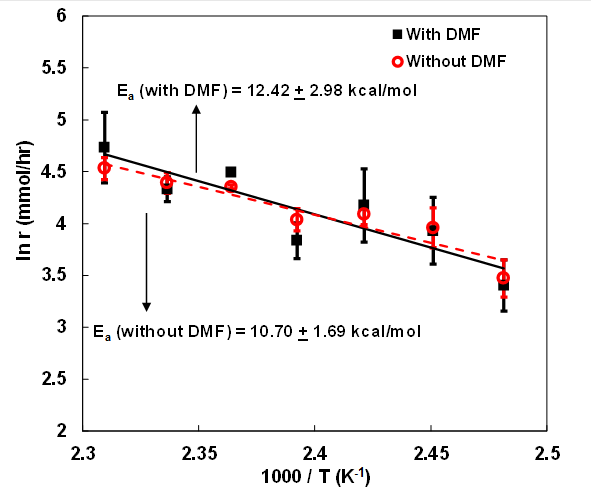
The reaction of 2,5-dimethylfuran (DMF) with ethylene to form p-xylene has achieved high selectivities (>90%) using an H-BEA (Si/Al=12.5) zeolite acid catalyst.1,2 As minimal xylene isomerization and transalkylation occurs under these conditions, this phenomenon was investigated and attributed to the surface site coverage of the ring opening product of DMF, 2,5-hexanedione.3 Using alcohol dehydration as a probe chemistry, the ability of 2,5-hexanedione (always present with the addition of DMF to solution), to inhibit the reactivity of unsaturated bonds was investigated. In the absence of DMF cyclohexene was quickly produced followed by subsequent consumption of the cyclohexene product (Figure 1a). The addition of DMF increases the cyclohexene yield by almost 50% and inhibits its subsequent consumption through secondary pathways. Apparent activation energies of cyclohexanol dehydration appear to be identical in the presence and absence of DMF, indicating that the presence of DMF does not affect the energetics of the dehydration reaction (Figure 1b).
| A
|
| B
|
 | |||
 |
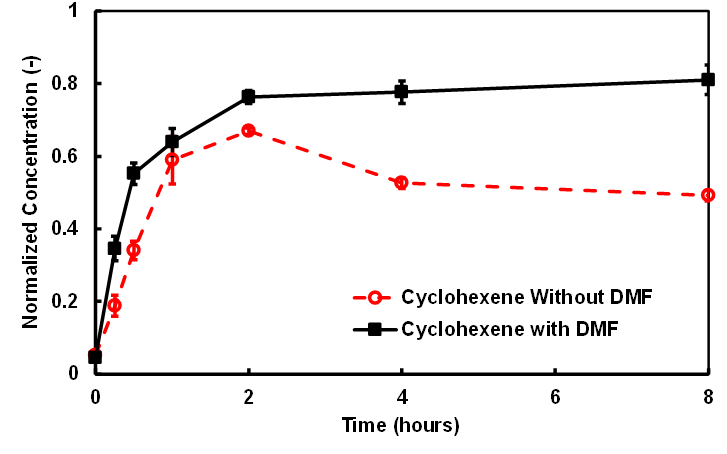
Figure 1. Cyclohexanol dehydration on H-BEA in the presence and absence of 2,5-dimethylfuran. A) Normalized concentration of cyclohexene to initial cyclohexanol concentration over time in the presence of and in the absence of 2,5-dimethylfuran. Reactions Conditions: 0.5 M cyclohexanol, 1.74 mM H-BEA (Si/Al 12.5), 160 °C, 200 psi N2 added at 22 °C, 82 mL heptane, 2 mL tridecane (internal standard), and 0.74 M 2,5-dimethylfuran, when added. B) Arrhenius plot of apparent rate of cyclohexanol conversion versus inverse temperature for reactions including and excluding 2,5-dimethylfuran. Apparent activation energies are displayed and within error. Reaction Conditions: 135 – 200 °C, 0.5 M cyclohexanol, 1.74 mM H-BEA (Si/Al 12.5), 160 °C, 200 psi N2 added at 22 °C, 82 mL heptane, 2 mL tridecane (internal standard), and 0.74 M 2,5-dimethylfuran, when added.
[1] Williams, C. L.; Chang, C.-C.; Do, P.; Nikbin, N.; Caratzoulas, S.; Vlachos, D. G.; Lobo, R. F.; Fan, W.; Dauenhauer, P. J. ACS Catal., 2012, 2, 935-939.
[2] Chang, C.-C.; Green, S. K.; Williams, C. L.; Dauenhauer, P. J.; Fan, W. Green Chem. 2014, 16, 585-588.
[3] Williams, C. L.; Vinter, K. P.; Patet, R. E.; Chang, C.-C.; Nikbin, N.; Feng, S.; Wiatrowski, M. R.; Caratzoulas, S.; Fan, W.; Vlachos, D. G.; Dauenhauer, P. J. ACS Catal., 2016, 6, 2076-2088.
See more of this Group/Topical: 2017 International Congress on Energy