
Multi-objective optimization of crude distillation unit, vacuum distillation unit and hydrocracking reactor in Diesel production process to maximize profitability and reduce greenhouse gases using NSPSO and NSGAII bioinspired techniques.
Johana ORJUELA, 1Camilo MONROY-PEÑA1,
1 Universidad Nacional de Colombia Universidad de Cundinamarca, Colombia
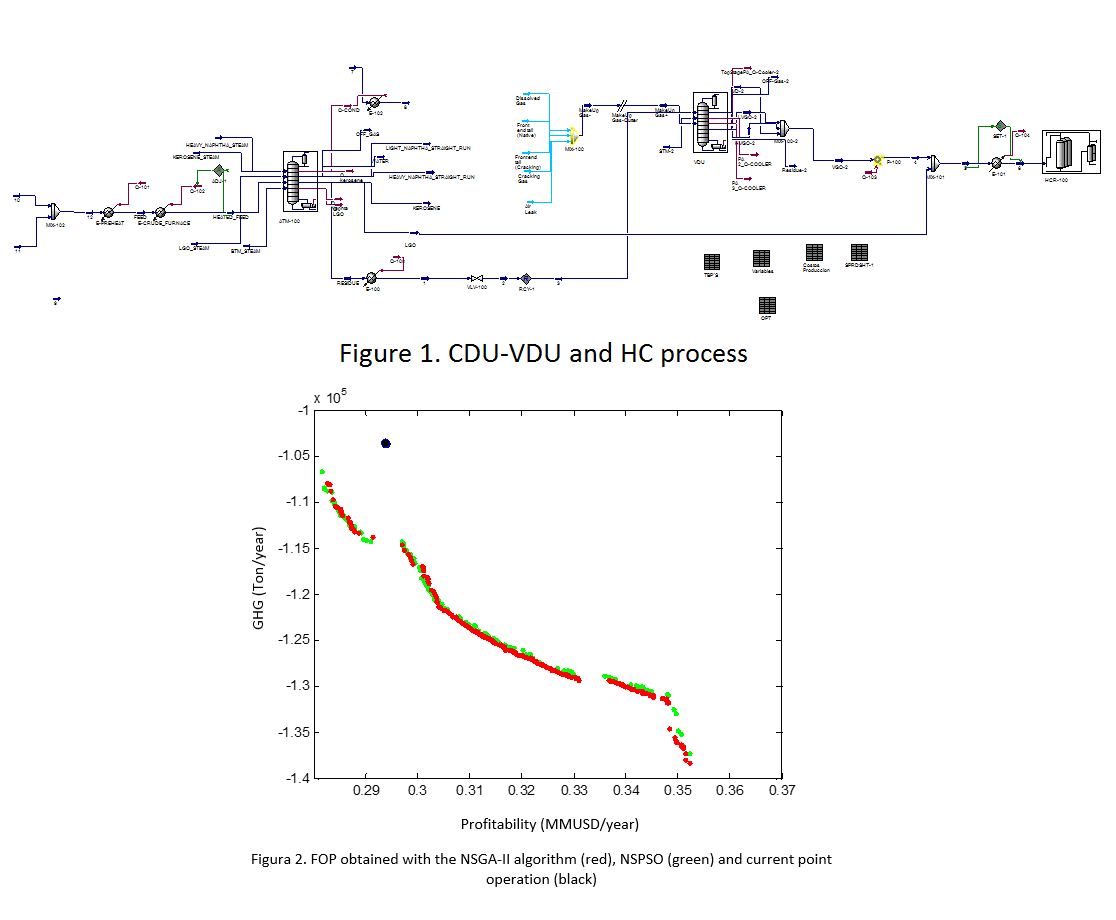
The present work compares the performance of two bioinspired algorithms: Nondominated Sorting Particle Swarm Optimizer (NSPSO) and Nondominated Sorting Genetic Algorithm II (NSGAII), as tools for solving a multi-objective optimization problem, applied to diesel production process, including Crude Distillation Unit (CDU), Vacuum Distillation Unit (VDU) and hydrocracking reactor (HC). Aspen Hysys ® simulation software is used as a tool for modeling and simulation of the process and Matlab as a tool for optimization and programming algorithms (Figure 1). Before the multi-objective optimization, the sensitivity analysis was performed in order to identify the independent variables that have the greatest impact on the objective functions (maximize the profitability of the process and minimize the emission of greenhouse gases). The ten variables that had the greatest impact on the objective functions were selected for optimization.
The results show that the NSPSO algorithm finds the best solution based on the optimal Pareto front obtained, allowing to select the different operating conditions of the three coupled units that maximize the profitability of the process and minimize the emission of greenhouse gases (GHG), maintaining the specifications of products, light naphtha, heavy naphtha, kerosene, gas oils (LGO, LVGO and HVGO) as well as diesel. Through the implementation of the multi-objective optimization was possible to increase the profitability of the process up to 20% and reduce the emission of GHG up to 30% compared to the industrial point of operation (Figure 2).
See more of this Group/Topical: Process Development Division