
Numerical Model for Streaming Dielectrophoresis
Rucha Natu, Monsur Islam and Rodrigo Martinez-Duarte
Department of Mechanical Engineering, Clemson University, Clemson, SC, USA
Here we present initial results for developing a simulation based model for particle separation using streaming dielectrophoresis (DEP). The technique of DEP induces particle movement in the presence of non-uniform electric field, towards or away from the field. This technique has been widely used for selective manipulation and trapping of wide variety of particles and cells. Combination of DEP with a flow field is an important technique for rapid separation. Streaming DEP works with an interaction of DEP and Drag force to form concentrated streams of selected particles. In the DEP Drag force field, the dominance of DEP force gives rise to trapping of particles, whereas dominance of Drag force gives rise to flow of particles. The effective manipulation of these two forces can create concentrated streams of the particles. The variation of particle streams as an effect of these forces is studied here by implementing COMSOL simulations. The stream widths are computed for different flow rates, frequencies, and voltages in a microfluidic chip. Simulations are also carried out for different shapes of electrodes to study the streaming zones for each case. Simulation considers 1um latex particles suspended in water as media. Simulations were experimentally using a 3D carbon electrode set up.
Simulation model considers a 3D carbon electrode set up, as fabricated by use of SU-8 photolithography. [1] The electrode domain consists of an array of 80 rows with 5 electrodes in each row, with alternate polarization. Streams are analyzed for circular, diamond and triangular shaped electrodes. The flow rate is varied from 10 to 1000ul/min and the frequencies used are 10-1000 kHz. The conductivity for the media is varied from 0.0005-0.5 S/m. The analysis of streams to compute the width of concentrated streams is completed using Matlab 2014, as detailed in our previous work. [2] By varying each parameter, the average magnitude of DEP and Drag force in the domain were calculated.
The stream width was obtained for different ratios of average Drag and DEP forces. It was observed that, for every shape of electrode, the device showed streaming only is a certain range of force ratio. In the regions with ratio being higher than this range, no streams were seen, whereas for the domain with force ratio lower than the range, all particles were trapped. For a particular electrode geometry, this range remained unchanged irrespective of the voltage, flow rate and the frequency used in the simulation. The plot for force ratio and the change in stream width for triangles, circles and diamonds is shown in the Figure 1a. Figure 1b shows the comparison for streams obtained in simulation compared to experiments. This comparison is at the flow rate of 100ul/min, with voltage 14V and frequency of 50 kHz. In case of the simulation, the streams are seen to leave the electrodes at the lateral sides, whereas in the case of experiment, streams focus at the center of the electrode. This difference in behavior is due to the nature of boundary layer mesh used in the simulations and the fact that the electrodes have a larger active surface area due to surface roughness than simulated. Irrespective of these differences, the nature of the streams in both cases is very similar.
The ongoing work is develop a technique to predict the streaming behavior in the dielectrophoretic chip based on applied parameters, i.e. voltage, frequency, flow rate, media conductivity and electrode geometry. The objective of this tool is to vary the parameters to cater the trapping or streaming behavior of cells in a dielectrophoretic chip as desired.
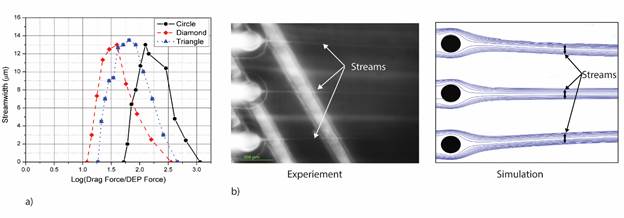
Figure 1: a) The figure shows the width of stream obtained at different simulated voltages, frequencies, flow rates and media conductivities with respect to corresponding force ratio for different shapes of electrodes. B) Validation of simulation using experiment at the flow rate of 100 ul/min and the frequency of 50kHz.
References:
1. Martinez-Duarte R., Renaud P., and Madou M., 2011, “A novel approach to dielectrophoresis using carbon electrodes,” Electrophoresis, 32(17), pp. 2385–92.
2. Natu R., and Martinez-Duarte R., 2016, “Numerical Model of Streaming DEP for Stem Cell Sorting,” Micromachines, 7(12), p. 217.
See more of this Group/Topical: 2017 Annual Meeting of the AES Electrophoresis Society