
Introduction: Tumors employ complementary overlapping mechanisms to evade immune surveillance, many emerging cancer immunotherapies attempt to target multiple pathways to eradicate malignant cells. Though modulation of independent pathways by simultaneous administration of multiple immune has shown great promise, the clinical impact remains limited due to severe toxicity associated with high systemic dosages. Localized injections at tumor sites may reduce systemic toxicity, however such approaches still require frequent injections of large amounts of drug (soluble proteins are rapidly diluted by lymphatic drainage and systemic circulation). For example, intra-tumoral injections of anti-CTLA-4 and anti-OX40 plus CpG were successful in generating systemic immunity to tumors, but required daily intratumoral injections of 100 µg/day/mouse for 5 days. Therefore, novel platforms for efficient delivery of combination therapies at lower doses would be enabling. Here, we describe immunomodulatory molecule delivery system (iMods), which provides sustained extracellular delivery of checkpoint inhibitor (anti-PD-L1) and, targeted intracellular delivery of a tumor antigen (OVA) along with adjuvant (poly(I:C)), and the indoleamine deoxygenase (IDO) inhibitor 1-MT.
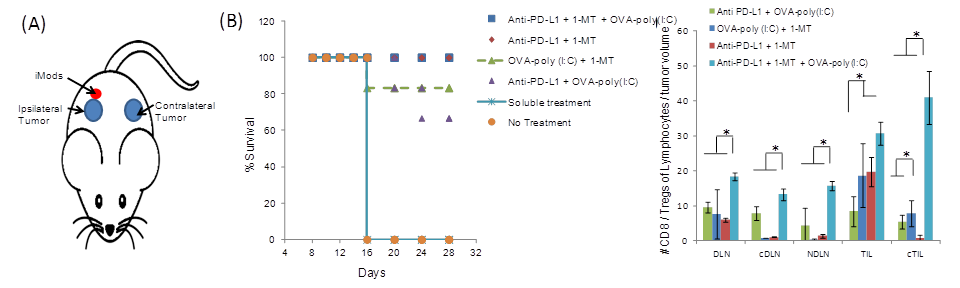
Methods: Contralateral melanoma B16F10 model was utilized. iMods containing OVA-poly(I:C), 1-MT, anti-PD-L1, in all possible combinations were injected in the periphery of the tumor (after the tumor was palpable). The size of the tumor was monitored till 30 days or till tumors were unbearable.

|
Figure. (A) Melanoma mouse model. (B) Survival curve for treatment groups and CD8/Treg ratios.
Conclusions: In summary, iMods develop potent systemic in vivo immune responses in the form of reduced numbers of Treg, and increased numbers of active CD8 T-cells in the tumor environment. Moreover, iMods formulations were able to generate systemic anti-tumor immunity via one-time local injection without lethal toxicity. iMods, as a platform, may be useful for the comparing a wide variety of combinatorial immunomodulating molecules in the context of cancer immunotherapy.
References: 1. Acharya et.al. Advanced Functional Materials 2017, 2. Acharya et.al. Journal of Drug Targeting 2016.
See more of this Group/Topical: Food, Pharmaceutical & Bioengineering Division