
Experimental Studies of 4.6-Dimethyldibenzothiohene Adsorption on Metal-exchanged Mesoporous Y Zeolites
Kevin X. Lee, George Tsilomelekis and Julia A. Valla
Department of Chemical & Biomolecular Engineering, University of Connecticut, 191 Auditorium Road, Unit 3222, Storrs, CT 06269-3222, USA,
Phone: +1-860-486 4602, e-mail: ioulia.valla@.uconn.edu
According to the latest transportation fuel regulations, the maximum allowable concentration of sulfur in diesel is 15 ppmw.1 This new limit corresponds to a 97% reduction of sulfur since 2005. Owing to the strict administrative standard, a majority of industries and research institutions face considerable challenges as further reduction and removal of sulfur from diesel fuels require more energy-intensive conditions and active catalysts. Alternatively, adsorptive desulfurization using metal-exchanged mesoporous Y zeolites has shown to be very effective in removing refractory sulfur compounds from transportation fuels.2 The introduction of mesoporosity improves mass transfer and minimize diffusion limitations of bulky sulfur compounds. The incorporation of metals such as Ce or Cu via the ion-exchanged method has shown to increase the adsorptive active sites, consequently improving the capacity and selectivity of sulfur compounds. The adsorption of thiophenic rings on metal cations can proceed either via the π-complexation or a direct S-M σ bond.3,4 The objective of this work is to extend our studies toward the desulfurization of a much larger thiophenic compound such as the 4,6-dimethyldibenzothiophene (DMDBT) using our novel catalyst. To the best of our knowledge, DMDBT removal by metal-exchanged mesoporous Y zeolite has yet to be reported, which is expected due to the bulky and unreactive nature of such molecule. This paper will highlight the remarkable desulfurization performance of DMDBT using metal-exchanged mesoporous Y zeolites, supported by fundamental IR spectroscopic experiments.
Metal-exchanged mesoporous Y zeolites were first prepared by introducing mesoporosity via a top-down surfactant-assistant technique.5 The mesoporous zeolite was subjected to an ion-exchange procedure to replace the protons with either Cu or Ce metals. The modified zeolites were characterized using various techniques. The crystallinity and porosity, as well as the presence of metal cations/nanoparticles were imaged using scanning transmission electron microscopy (TEM). The pore size distribution and crystal structure were identified using N2 adsorption/desorption isotherm and x-ray diffraction (XRD), respectively. Surface acidity and metal distributions were determined using pyridine and CO adsorptions by diffuse reflectance infrared spectroscopy (DRIFT-FTIR), respectively. DRIFTS-FTIR experiments were also used to study the adsorption mechanism of thiophenic compounds on various modified zeolites. The metal loadings on the zeolite were quantified using ICP.
Breakthrough experiments were conducted in a fixed-bed column to study the dynamic adsorption of model fuel (DMDBT in octane). The desulfurized effluent was collected periodically until saturation had been reached and analyzed using a gas-chromatograph-sulfur chemiluminescence detector (GC-SCD). Figure 1 shows the breakthrough curves of DMDBT adsorbed on parent and modified Y zeolites. The parent Y shows an extremely early breakthrough of DMDBT, suggesting diffusion limitations toward the internal active sites. This is confirmed when the use of mesoporous Y zeolite (ie. SAY) extended the breakthrough point from 0 to 150 mL/g of sulfur-free fuel produced. Metal-exchanged mesoporous Y zeolite (ie. CuSAY) has shown to improve the removal of DMDBT by about 20 mL/g. The best desulfurization sorbent was reported by bimetallic mesoporous Y zeolite as nearly 200 mL/g of DMDBT-free fuel was produced. These results suggest that in combination with the mesopores, the synergistic effects of Ce and Cu metals significantly improve the capacity and selectivity of DMDBT.
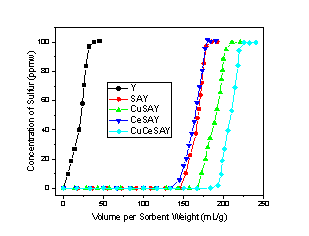
Figure 1: Breakthrough Curves of DMDBT on various Y-derived zeolites.
The adsorption mechanism of sulfur on Y zeolites can be revealed by FTIR studies. About 25 mg of zeolite was weighed into the DRIFT cell and activated in-situ with either H2 or N2 for 1 hour. Upon activation, DMDBT solids were added into the cell and allowed to adsorb at 200 °C. Temperature programmed desorption (TPD) studies were carried out to investigate the sites at which DMDBT is adsorbed. Figure 2 shows the DMDBT adsorption spectra on the parent Y zeolite. The OH region on the left shows that DMDBT adsorbs on the acidic hydroxyl sites (3630 cm-1 and 3550 cm-1) more preferentially than the silanol sites (3741 cm-1). TPD profile shows that the hydroxyls begin to restore at 350 °C. On the CC region, peaks at 1640, 1570, 1480, 1445, 1413, and 1375 cm-1 are apparent. The peaks at 1570 cm-1 and 1480 cm-1 are a consequence of a shift to higher wavenumbers, implying an increase in electron density. The positive shift is typical when new σ-bonds are formed, suggesting a direct interaction (ie. H-bonding) of the proton in the zeolite with the sulfur in the DMDBT ring. Meanwhile, the peaks located at 1445 cm-1, 1413 cm-1 and 1375 cm-1 represent a shift to lower wavenumbers upon adsorption of DMDBT on the parent Y. This negative shift implies that the proton can also interact with the DMDBT ring, resulting in a loss in electron density. The same IR study can be conducted on the other modified Y zeolites to fully understand the adsorption mechanism, as well as the internal active sites at a fundamental level.
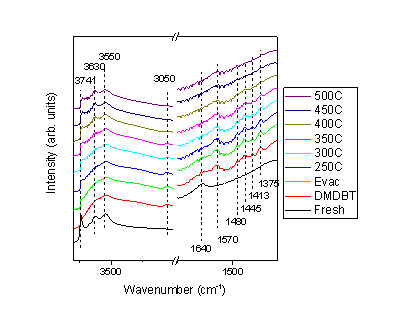
Figure 2: O-H and C-C vibration regions of DMDBT adsorption parent Y zeolite.
References
1. U.S. Environmental Protection Agency. EPA sets Tier 3 motor vehicle emissions and fuel standards. (2014). Available at: https://www.epa.gov/regulations-emissions-vehicles-and-engines/final-rule-control-air-pollution-motor-vehicles-tier-3. (Accessed: 2nd March 2016)
2. Lee, K. X. & Valla, J. A. Investigation of bifunctional zeolites for the adsorptive desulfurization of fuels. Appl. Catal. B Environ. 201, 359–369 (2017).
3. Hernández-Maldonado, A. J., Yang, F. H., Qi, G. & Yang, R. T. Desulfurization of transportation fuels by π-complexation sorbents: Cu(I)-, Ni(II)-, and Zn(II)-zeolites. Appl. Catal. B Environ. 56, 111–126 (2005).
4. Velu, S., Ma, X. & Song, C. Selective Adsorption for Removing Sulfur from Jet Fuel over Zeolite-Based Adsorbents. Ind. Eng. Chem. Res. 42, 5293–5304 (2003).
5. García-Martínez, J., Johnson, M., Valla, J., Li, K. & Ying, J. Y. Mesostructured zeolite Y—high hydrothermal stability and superior FCC catalytic performance. Catal. Sci. Technol. 2, 987 (2012).
See more of this Group/Topical: Separations Division