
Ceramic Hollow Fiber Supported Metal-Organic Framework Uio-66 for Enhanced Adsorptive Separations
Chenghong Wang,a, b Dr. Melanie Lee,a Dr. Xinlei Liu,a Dr. Bo Wang,a
Professor J. Paul Chen,b and Professor Kang Li*a
a The Barrer Center, Department of Chemical Engineering, Imperial College London, London SW7 2AZ, United Kingdom
b NUS Graduate School for Integrative Sciences & Engineering (NGS), Department of Civil and Environmental Engineering, National University of Singapore, Singapore, 117456, Singapore
ABSTRACT
A novel ceramic hollow fiber was prepared through controllable spinning and sintering to form a two-distinct-layer geometry: one very thin barrier layer containing 3D-pore network structure at the lumen, and one unique layer containing a plurality of conical micro-channels towards the shell side.[1] These micro-channels not only reduce the mass transfer resistance as a transport network, giving rise to competitive permeation fluxes, but also form pockets within which functional materials can be readily deposited.
Recently, metal-organic frameworks (MOFs), a new class of porous materials, has exhibited a great potential in various applications, owing to their unique properties like exceptionally high porosity, large surface area and customizable chemical functionality.[2] One of the representative examples is UiO-66, a zirconium-based MOF, which has shown the best adsorption capacity for arsenic removal from wastewater.[3] However, the current discussion regarding MOF adsorbent is majorly based on the particle samples. In order to be industrially applicable, the powder materials have to be specifically shaped or supported, since in practical dispersed particles would easily leak through the application compartment, resulting in challenging spent-particles-separation issues and severe safety concerns.[4]
Herein, we developed and optimized a functional adsorptive membrane by incorporating UiO-66 into the ceramic hollow fiber. The fast adsorption kinetics provided by UiO-66 allows an efficient adsorptive separation process to be realized within the micro-channels, and the thin barrier layer can prevent any loss of the active adsorbents from leaking out. As a proof of concept, this adsorptive membrane was found to be capable of effectively remediating arsenic contaminated water and producing potable water recovery (less than 10 ppb – required by World Health Organization). In comparison, to achieve a similar performance, the conventional adsorption packing column required eight times amount of active UiO-66 adsorbents. Hence, this adsorptive membrane has exhibited a promising potential to be applied for industrial wastewater decontamination. Looking forward, different functional membranes can be prepared based on specific adsorptive applications, as a wide range of adsorbents can be loaded into this novel ceramic hollow fiber, of which the micro-channel size and barrier layer pore size can be easily manipulated during fabrication.
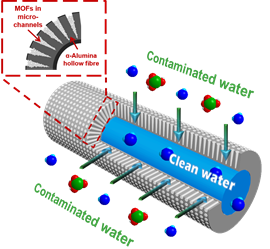
Figure 1. Schematic diagram of arsenic contaminated water remediation by the adsorptive membrane. The inset demonstrates an enlarged cross-sectional view of the adsorptive membrane. Blue molecule: water; green molecule: arsenic pollutant.
KEYWORDS
MOF, ceramic hollow fiber, adsorption, arsenic, water remediation
REFERENCES
[1] M. Lee, B. Wang and K. Li, J. Membr. Sci., 2016, 503, 48.
[2] H. Furukawa, K. E. Cordova, M. O'Keeffe and O. M. Yaghi, Science, 2013, 341, 1230444.
[3] C. Wang, X. Liu, J. P. Chen and K. Li, Sci Rep, 2015, 5, 16613.
[4] J. He, T. S. Siah and J. Paul Chen, Water Res., 2014, 56, 88.
ACKNOWLEDGEMENTS
This work was supported by the research funding provided by Engineering and Physical Sciences Research Council in the United Kingdom (Grant no. EPSRC, EP/J014974/1). C. Wang gratefully acknowledges the National University of Singapore Graduate School for Integrative Sciences and Engineering scholarship.
See more of this Group/Topical: Separations Division