
The spreading of liquids is a classical problem in interfacial fluid mechanics and, historically, the examination has been limited to immiscible systems. We have reported previously on our experimental studies and observations of the spreading of sessile drops in miscible environments, which have distinctly different shape evolution and power law dynamics from sessile drops that spread in immiscible environments. We have extended this experimental work to include the shape evolution of pendant drops existing in a miscible environment. By examining pendant drops, the need to account for surface energies arising from a solid-fluid interface, as in the case of a sessile drop, is eliminated. We have complemented these experimental studies with a theoretical scaling analysis as well as numerical simulation.
As time evolves, diffusion across the miscible liquid-liquid boundary proceeds due to the chemical potential difference between the two initially distinct, homogeneous phases. Diffusion, in turn, imparts a time-dependence to the properties of the liquids in the diffusive region – notably the density, viscosity, and interfacial tension – that influence the shape evolution. It was found for these droplets in miscible environments that gravitational forces dominate the shape evolution process. The presence of diffusion sets up a fluid flow of free convection in the case of a pendant drop in a miscible environment; in the case of a sessile drop in a miscible environment, free convection occurs in tandem with spreading along the solid substrate.
A series of liquid pairs (corn syrup-water, glycerol-water, glycerol-ethanol, tricresyl phosphate-ethanol, silicone oil-silicone oil) and volumes of droplets have been studied. Solving the convection-diffusion and Stokes equations numerically and in tandem has been used to simulate these systems, which quantitatively match observations of the experiments. This poster will present the sessile and pendant drop work together, spanning the experimental, theoretical, and numerical work.
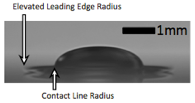
Figure 1: Side view of a miscible sessile drop of corn syrup immersed in water.
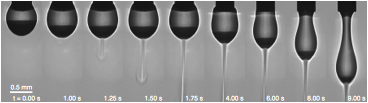
Figure 2: Image sequence taken in time of a corn syrup pendant drop immersed in water. A strand emanates from the apex of the drop and continues to flow as the entire drop descends and elongates.
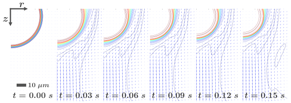
Figure 3: Numerical simulation of a pendant drop in a miscible environment evolving in time.
See more of this Group/Topical: Engineering Sciences and Fundamentals