
Reaction network structure and flux analysis for thin-film deposition processes.
Hossein Salami, Raymond A. Adomaitis
Chemical Vapor Deposition (CVD) and Atomic Layer Deposition (ALD) are vapor-based processes for production of thin solid films in which heterogeneous and homogenous reactions with widely ranging time scales are involved. Proposing an accurate reaction mechanism consisting of adsorption/desorption and reactions within various phases that results in a well-posed species balance is among the first steps in studying these processes. A valid reaction network (RN) combined with accurate kinetic data is vital for process modeling and optimization and forms the backbone of further engineering analysis.
In this contribution, we will introduce an analysis approach based on RN graphs and linear algebra methods which provides a mechanistic framework for answering four critical questions regarding the validity of a proposed reaction RN prior to the often time-consuming step of calculating individual reaction rates and any attempt to solve the system of differential equations produced by species balances:
1. Can the equilibrium and finite-rate reaction time scales be decoupled and independently measured?
2. What is the physical origin of time-independent modes in the system’s dynamic behavior and how they can be used to validate the proposed RN?
3. Does the proposed RN result in a unique film stoichiometry that is independent of reaction rates?
4. Does the RN pose a self-limiting mechanism essential to a true ALD process?
The first question can be answered by finding a transformation which essentially separates the effect of different reaction rates and defines new variables in the form of reaction variants and invariants that are linear combination of original concentrations [1]. However, this approach does not provide answers to the remaining questions and additional analysis is required. The approach we will describe is based on the species-reaction graphs introduced by Craciun and Feinebrg [2] and provides a set of rules which can be used to answer above questions using the graph constructed from the RN under study without requiring any knowledge regarding individual reaction rates.
Furthermore, we demonstrate the application of our RN graphs in material flux analysis and in studying the sensitivity of the RN to the process parameters such as the reactor temperature and precursor partial pressure. We also will assess its potential for extension to other areas in chemical engineering research, such as metabolic engineering or polymerization reactions.
In this talk, we use the RN associated with the titania ALD process based on titanium isopropoxide (Ti(iPrO)4 or TTIP) / water precursors as a representative case to show the applicability of the proposed approach. This process has been shown to deviate from an ideal self-limiting ALD at temperatures greater than 250 oC where the rate of hydrolysis reactions begins to decrease while pyrolysis reactions are activated [3,4]. The relative contribution of ALD versus CVD growth mode to TiO2 film deposition will be assessed using our flux analysis method and the results will be presented in the context of the RN graphs.
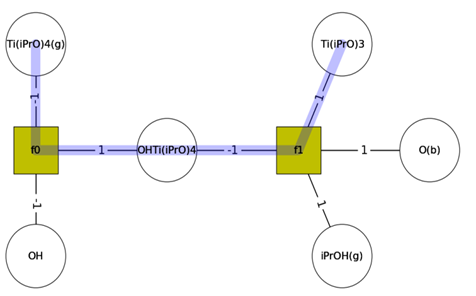
Figure 1. The sub-graph associated with the initial adsorption of TTIP molecule on a hydroxylated surface in titania ALD process. The blue color highlights the path which can be used to derive the formula for the time-independent mode associated with conservation of titanium atoms in the reactor. (g) and (b) refer to bulk and gas phases, others are surface species.
[1] D. Rodrigues, S. Srinivasan, J. Billeter, D. Bonvin, Comput. Chem. Eng., 2015, 73, 23.
[2] G. Craciun, M. Feinberg, SIAM J. Appl. Math., 2006, 66(4), 1321.
[3] A. Rahtu, M. Ritala, Chem. Vap. Deposition, 2002, 8, 21.
[4] M. Reinke, Y. Kuzminykh, P. Ho_mann, J. Phys. Chem., 2016, 120(8), 4337.
See more of this Group/Topical: Computing and Systems Technology Division