
Automated Selective Cell manipulation using Dielectrophoresis
Rucha Natu, Monsur Islam, Rodrigo Martinez Duarte
Department of Mechanical Engineering, Clemson,SC
Here we present a novel technique for automated cell manipulation using a dielectrophoretic chip with motion activation using a 3d printer. Dielectrophoresis is widely used for selective cell manipulation and trapping. Due to its ability for rapid, label free cell sorting at a high efficiency, dielctrophoresis is a promising technique for sample preparation. Use of 3D electrodes has enhanced the region for action of DEP field and shows a capability of obtaining high throughput. The technique developed by our group uses the advantage of 3D carbon electrodes as a first step towards sample preparation. A 3D carbon electrode DEP chip is used to trap and transfer selected cells to the process plate. The final objective is to integrate cell separation and lysis on the automated chip to obtain the intra cellular material for sample processing.
A 3D carbon electrode chip, fabricated by SU8-Photolithography, as detailed by our group previously, [1] is used for this experiment. The chip is mounted on a 3D printer facing the printer platform. The 3d printer is programmed using G-code to control the motion of the chip. The setup is shown in Figure 1a. The chip is first immersed in the cell culture plate, which contains a mixture of cells and particles. A mixture of 10um latex particles and Candida albicans is used for this process. At 200 kHz, and 20Vpp, Candida albicans are trapped by positive dielectrophoresis whereas the latex particles are not trapped. The chip with the trapped cells is raised from the culture by the 3D printer and is transferred to the wash plate. As, the chip is raised out of the culture plate, the media wets the chip. Some cells and 10um particles remain suspended in the media and get carried along with the chip. In the wash plate, the untrapped cells and the latex particles, acquired due to wetting of the chip are removed. Since the electric field remains ‘ON’ during this step, the candida albicans remain trapped. In the next step, the chip is immersed in the sample plate, where the field is switched ‘OFF’. In the absence of the DEP force, the candida cells are released in the sample plate. The process is shown in details in the schematic in Figure 1b. The cells retrieved in the sample plate with DEP and without DEP were counted to determine the concentration of the cells obtained in sample plate. When DEP field is off, the cells get transferred as the water wets the electrode surface. The graph in Figure 1c, shows the difference in the concentration of cells obtained in the sample plate in both cases. The higher concentration in the case of DEP proves that DEP can be used to effectively transfer selected cells.
Current work is to develop the process to completely eliminate the cell transfer due to wetting. The number of cells transferred are being characterized as a function of applied voltage and the concentration of cell culture. The final objective is to develop the device for sample preparation, where with the increase of voltage in the chip and thus the resulting electric field, the cells can be lysed. The intra cellular material after cell lysis can be deposited at the sample site directly. Use of 3D printer can enable control of the chip motion and hence the cells or intra cellular material can be dropped at specific locations automatically.
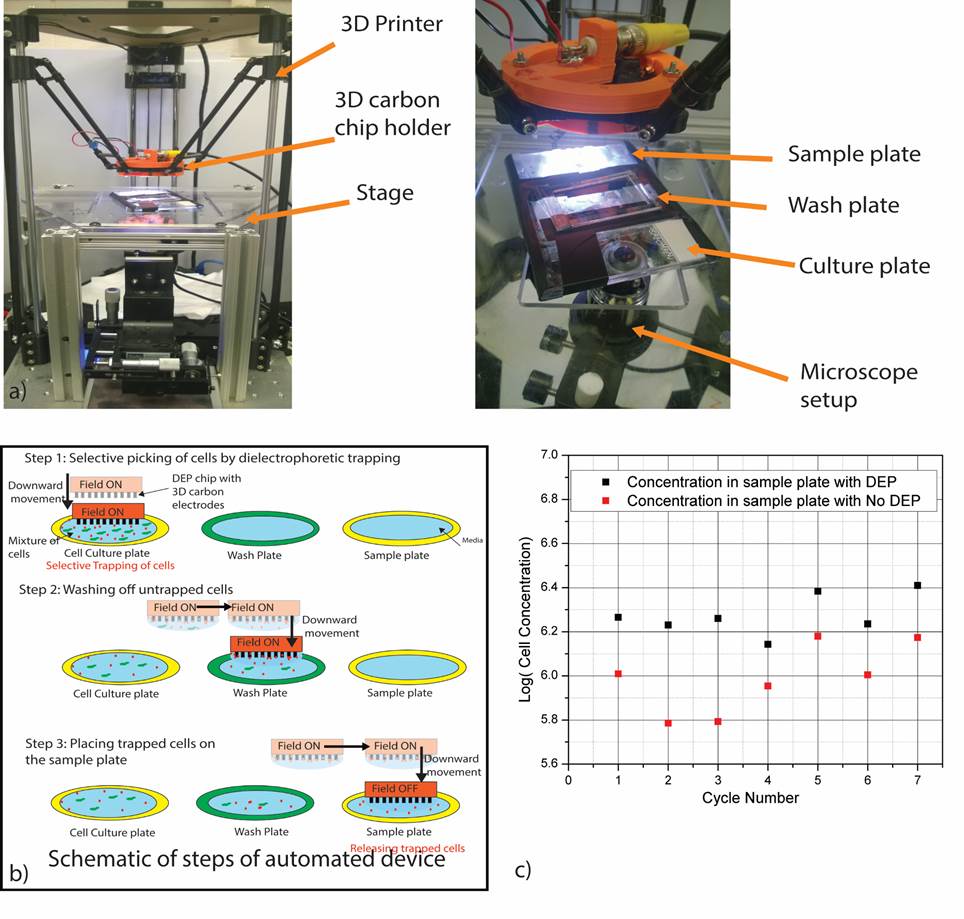
Figure 1a) The 3d printer set up with the DEP chip mounted on the holder is shown in the figure. b)The schematic of the cell transfer device shows steps involved in picking and transferring the cells from culture to sample plate c) The plot of log of cell concentration obtained after each cycle is shown in this graph. Number of cells obtained in every cycle with DEP are more than the number of cells obtained in the cycles without DEP. This indicates that the DEP chip can be used to transfer
References:
[1] Martinez-Duarte R., Renaud P., and Madou M., 2011, “A novel approach to dielectrophoresis using carbon electrodes,” Electrophoresis, 32(17), pp. 2385–92
See more of this Group/Topical: 2017 Annual Meeting of the AES Electrophoresis Society