
An inexpensive, point-of-care urine test for bladder cancer in patients
1 Department of Chemical and Petroleum Engineering, University of Pittsburgh, PA
2 Department of Bioengineering, University of Pittsburgh, PA
3 Department of Pharmaceutical Sciences, University of Pittsburgh, PA
4 Department of Immunology, University of Pittsburgh, PA
5 Department of Ophthalmology, University of Pittsburgh, PA
6 Department of Urology, University of Pittsburgh Medical Center, PA
7 McGowan Institute for Regenerative Medicine, University of Pittsburgh, PA
8 Department of Biostatistics, Graduate School of Public Health, University of Pittsburgh, PA, USA
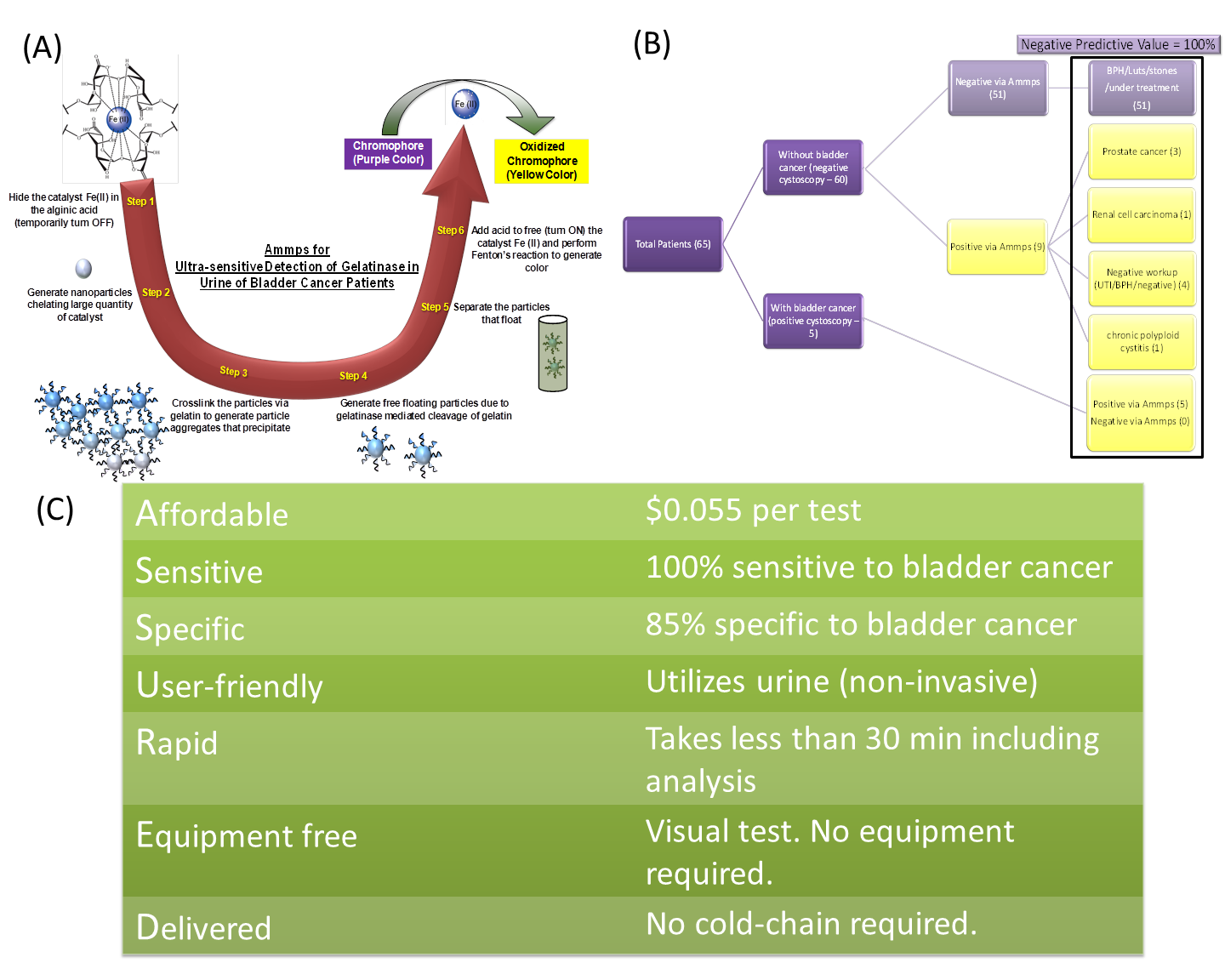
Hematuria is the most common symptom of bladder cancer (BC), but only 5-30% of the evaluated patients (via expensive tests) are positive for BC, which makes BC one of the most expensive cancers to treat. Therefore, a cost-effective, office-based test that reliably rules out BC in hematuria evaluation is greatly needed. Herein a urinary assay for a BC biomarker matrix metalloproteinases-2 and -9 (MMP2/9) (“Ammps”) is presented, which follows WHO’s ASSURED guidelines, are non-invasive, cost-effective, and based on the MMP2/9 activity on the Ammps substrates. Ammps substrates, are composed of gelatin-crosslinked-alginate nanoparticles chelating large amounts of Fe(II), which identify MMP2/9 activity by initiating an autocatalytic Fenton’s reaction. In a study of 88 patients, Ammps had 100% sensitivity, 85% specificity, and a negative predictive value (NPV) of 100%. This high NPV can be useful in ruling out BC in hematuria evaluation and can have a broad impact in cancer detection.
Introduction: Bladder cancer (BC) patients require continuous monitoring due to its high recurrence rate. State of the art monitoring of BC is performed using cystoscopy, which is an expensive and invasive procedure. Moreover, since monitoring remains essential throughout the life of the patient, BC is one of the most expensive malignancies to treat from detection to death.
Materials and Methods: Ammps were performed on urine donated by 88 patients (on the same day of donation) suffering from different diseases including bladder cancer, prostate cancer, benign prostate hyperplasia, urinary tract infection among others. The experiments were performed according to the IRB protocol approved by UPMC.
Results and Discussion: Ammps follow the ASSURED guidelines as shown by the table here (above). Moreover, Ammps detect 100% of untreated bladder cancer patients, and generate a range of color for treated bladder and prostate cancer patients.
Conclusions: Ammps, a point-of-care urine test that may be utilized for the detection and surveillance of bladder cancer. This test can be cost-effective, is instrument free, and can be performed in a clinical setting. Ammps has a high negative predictive value and sensitivity for detection of bladder cancer, and thus also has the potential to serve as a screening test in high risk populations. With its capacity for bladder cancer diagnostics at the bedside and ability to satisfy the WHO’s ASSURED criteria, Ammps can also have an impact on monitoring of, and possibly screening for, bladder cancer in resource-poor settings. A larger prospective trial is underway to confirm these results.
Figure 1. (A) The mechanism of Ammps. (B) Ammps show 100% negative predictive value for bladder cancer in hematuria positive population. (C) Ammps follow ASSURED criteria set by WHO.
See more of this Group/Topical: Food, Pharmaceutical & Bioengineering Division