
Hydroisomerization of alkanes occurs through kinetic cascades mediated by alkene intermediates that require a (de)hydrogenation metal function within diffusion distances of the kinetically-relevant acid function. Hydrodeoxygenation of alkanols similarly requires a hydrogenating metal function proximal to kinetically relevant acid sites to scavenge dehydrated product alkenes and prevent catalyst deactivation with no influence on rates. In practice, the location and distribution of metal clusters with respect to acid sites—and thus their proximity—is seldom well-characterized because metal precursors are deposited onto bound solid acids that also contain inert metal-oxide binders during synthesis protocols. The accepted intimacy criterion for bifunctional isomerization [1] requires that the metal and acid functions reside at distances (~100 um for mesoporous solid acids) that prevent concentration gradients of alkenes—derived from reactant alkanes in isomerization and formed from oxygenates via dehydration for hydrodeoxygenation—within acid domains. Indeed, for zeolite crystals with an extracrystalline metal function present in the form of Pt/SiO2, distances of ~150 nm are sufficient to maintain constant alkene reactant concentration within acid domains, as shown by isomerization rates that are unaffected by the size or intracrystalline site density of zeolite crystals. We find, however, that as metal-acid distances approach the nanometer scale via introduction of the metal function as intracrystalline clusters using exchange methods, isomerization rates are markedly higher. These remarkable yet previously unexplained effects of site proximity and their mechanistic underpinnings are addressed in this study. Turnover rates (per H+) (i) for n-heptane isomerization on Pt-exchanged MFI and on physical mixtures of Pt/SiO2 with MFI (of varying site density ([H+]) and crystal size) and (ii) for 4-methylcyclohexanol, 2-butanol, and 2-propanol hydrodeoxygenation on physical mixtures of Pt/SiO2 with FAU and BEA and on physical mixtures of Pt/SiO2 with Pt-exchanged FAU and Pt-exchanged BEA. We also report turnover rates for probe reactions selective to each of the two functions to assess their monofunctional reactivities as the distances separating them decrease. Acid sites are characterized by turnover rates for methanol dehydration [2], a reaction that sensitively probes acid reactivity and any consequences of changes in acid strength or confining environment as a result of proximity; the metal function is assessed using CO oxidation rates [3], which are able to report on changes in electronic properties of Pt clusters as a result of their proximity to zeolitic protons.
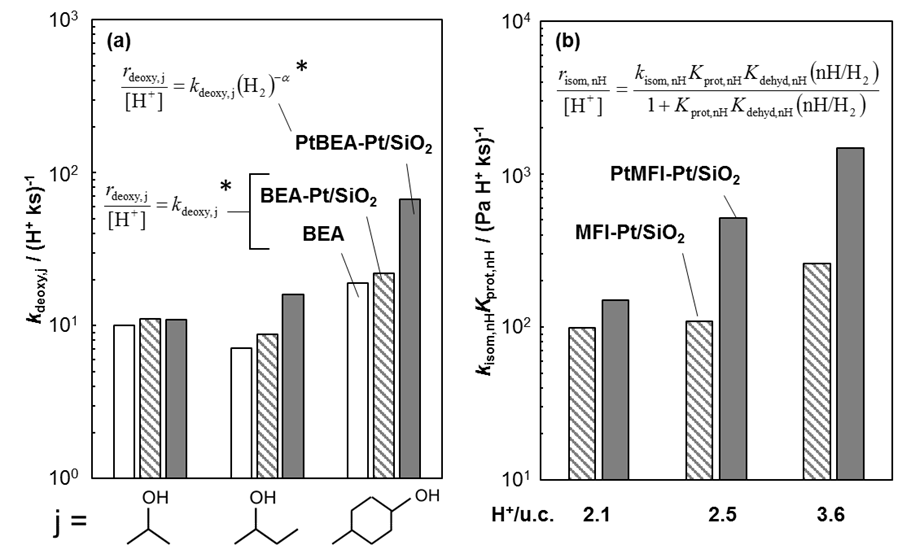
n-Heptane isomerization turnover rates (548 K, 60-101 kPa H2, 5 kPa n-heptane: ~70 molec. (H+ ks)-1) on MFI (of different crystallite size and site density; mixed with Pt/SiO2) are invariant with the Thiele modulus, the dimensionless quantity that rigorously describes reactant concentration gradients, until large values of the Thiele parameter (corresponding to metal-acid separation of ~250 nm) at which point rates decrease by about twofold. Thus, smaller metal-acid distances lead to negligible intracrystalline heptene concentrations, the required intimacy criterion [1] has been satisfied for these bifunctional catalysts with metal function present only as extracrystalline Pt/SiO2. Alkanol dehydration turnover rates (393 K, 2 MPa H2, 2.5 kPa 4-methylcyclohexanol: ~25 molec. (H+ ks)-1) were measured on BEA and FAU (0.60 and 0.74 nm apertures, respectively, compared to 0.47 nm in MFI [4]). Dehydration turnover rates are much lower than those for n-heptane isomerization, which, taken together with the larger molecular diffusivities afforded by large pore frameworks, precludes the presence of concentration gradients of methylcyclohexene products. Concentrations of products measured are much lower than those predicated by equilibrated reactant dehydration, indicating that further decreases in metal-acid site proximity should be inconsequential. In contrast to these expectations, we measure unexpectedly significant increases (by factors of 2-9) in reaction rate constants (Figure 1a for 2-butanol and 4-methylcyclohexanol on BEA, BEA-Pt/SiO2, and PtBEA-Pt/SiO2; Figure 1b for n-heptane isomerization over MFI-Pt/SiO2 and PtMFI-Pt/SiO2 for MFI of different site density) for both isomerization and hydrodeoxygenation when Pt clusters and H+ reside within the intracrystalline framework at distances of ~5-20 nm—as estimated assuming uniform distribution of each of the two functions during synthesis procedures.
|
Figure 1. (a) Measured dehydration turnover rate constants (per H+) for 2-propanol, 2-butanol, and 4-methylcyclohexanol on BEA, BEA-Pt/SiO2, and PtBEA-Pt/SiO2 (393 K; 0.5-2.5 MPa H2; 0.1-10 kPa alkanol). Inset equations are rate expressions. *2-Propanol dehydration is independent of P(H2) for PtBEA-Pt/SiO2. (b) Measured n-heptane isomerization turnover rate constants (per H+) on MFI-Pt/SiO2 and PtMFI-Pt/SiO2 for MFI of varying proton density (548 K; 60-101 kPa H2; 0.1-25 kPa n-heptane). |
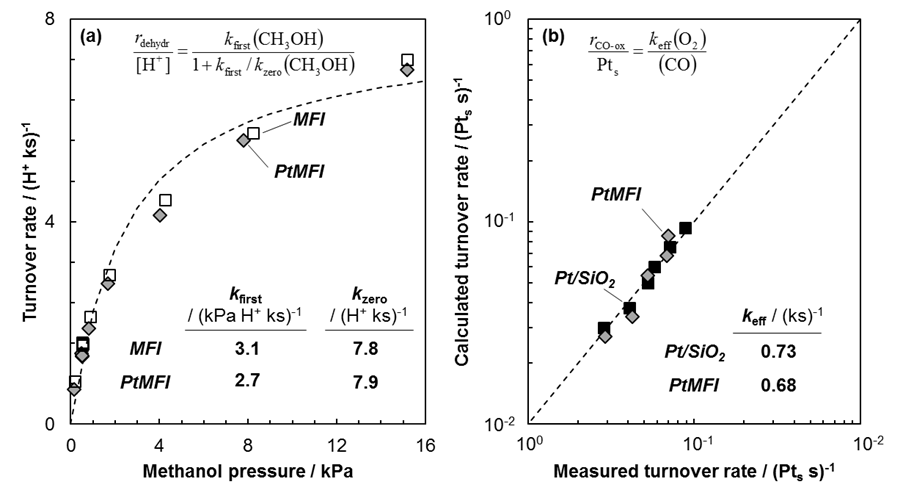
The nanoscale proximity between metal and acid function could potentially result in cooperative behavior changing the inherent monofunctional reactivity. Alkene skeletal isomerization and alkanol dehydration steps limit the respective rates of alkane isomerization and alkanol hydrodeoxygenation. Any potential changes in acid reactivity, caused by modification of acid strength and local environment for acid sites as a result of proximate Pt clusters, were assessed using methanol dehydration turnover rates (per H+; 433 K) were measured on both MFI and on PtMFI (Figure 2a). Turnover rates and rate constants (inset in Fig. 2a) are the same, consistent with unperturbed reactivity and properties of the acid sites. CO oxidation turnover rates and rate constants (per Pts; 443 K) on Pt/SiO2 and Pt-MFI are also the same (Figure 2b and inset), indicating that the reactivity and properties of Pt clusters are unaffected by their confinement or by their proximity to acid sites within intracrystalline regions. Thus, we conclude that the monofunctional reactivity of the individual metal and acid functions are unaffected by their close proximity.
|
Figure 2. (a) Measured methanol dehydration turnover rate (per H+) on MFI and PtMFI (433 K). Dashed curve represents average regressed fit to the inset rate expression; regressed values of first- and zero-order rate constants inset. (b) Parity plot for CO oxidation turnover rates (per Pts) on Pt/SiO2 and PtMFI (443 K). Rate expression and values of effective rate constants inset. Dashed line represents parity. |
These significant rate enhancements for isomerization and dehydration reactions must occur via highly reactive intermediate species. We surmise that these short-lived intermediates are present only at low concentrations and thus require metal clusters within nanometer distance from acid sites. Rate enhancements for 2-butanol and 4-methylcyclohexanol but not 2-propanol dehydration (Figure 1a) shed light on the identity of such reactive intermediates. Additionally, alkanol dehydration turnover rates are independent of P(H2) on BEA and on BEA-Pt/SiO2; however, turnover rates for 2-butanol and 4-methylcyclohexanol become inversely dependent on P(H2) when Pt is present in nanometer proximity from acid sites (Fig. 1a inset). These kinetic data, together with insights from density functional theory, implicate unsaturated alkenone/alkenol analogs of reactants as plausible intermediates for dehydration reactions. Such a pathway is unavailable for 2-propanol because the analogous alkenol cannot undergo dehydration and consequently does not impact its measured rates. The identity of highly reactive intermediates mediating isomerization remains under investigation. Unlike for alkanol dehydration, isomerization rates show no change in P(H2) dependence with encapsulation of Pt clusters, thus excluding diene-derived intermediates. We continue to apply density functional theory treatments to assess the plausibility of species as alkene-derived intermediates for isomerization.
We have addressed previously uninterpreted enhancements in reaction rates as they arise from nanoscale metal-acid site proximity. Such insights can be applied to optimize industrial catalysts for these and other analogous reactions.
References
[1] P.B. Weisz, Adv. Catal. 13 (1962) 137–190. doi:10.1016/S0360-0564(08)60287-4.
[2] A.J. Jones, R.T. Carr, S.I. Zones, E. Iglesia, J. Catal. 312 (2014) 58–68. doi:10.1016/j.jcat.2014.01.007.
[3] A.D. Allian, et al., J. Am. Chem. Soc. 133 (2011) 4498–4517. doi:10.1021/ja110073u.
[4] C. Baerlocher, L. McCusker, Database of Zeolite Structures. http://www.iza-structure.org/databases/.
The authors thank Zhichen (Jane) Shi for measurement of diffusion timescales of zeolite samples. Additionally, the authors acknowledge financial support from Chevron Energy Technology Company and computational resources from the National Science Foundation’s Extreme Science and Engineering Discovery Environment (ACI-1053575).
See more of this Group/Topical: Catalysis and Reaction Engineering Division