
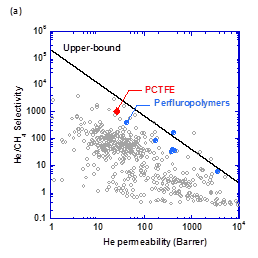
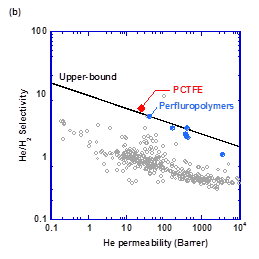
Polymeric membranes have been widely used for industrial gas separation due to their inherent advantages such as high energy-efficiency. There is a great interest in understanding the polymer structure/property relationship to design high performance membranes with high gas permeability and selectivity. Halogenated polymers have emerged as interesting membrane materials for gas separation. For example, perfluoropolymers govern the upper bounds for He/H2, He/N2, and He/CH4 separation in the Robeson’s plots, which is ascribed to the more favorable interactions for He than other gases with fluoropolymers, as shown in the Figures above. Herein, we demonstrate that chlorine groups exhibit unique separation properties for the removal of noble gas from mixtures, as exemplified in polychlorotrifluoroethylene (PCTFE, -CF2-CFCl-). At 35 oC, PCTFE exhibits a He permeability of 26 Barrers and pure gas selectivity of He/H2, He/CO2 and He/CH4 of 6.2, 53 and 1,100, respectively. These selectivity values are among the highest reported, and the performance is near or above the upper bounds for these separations. Interestingly, PCTFE also shows a H2/CO2 selectivity of 8.5 at 35 oC, an attractive performance for H2 purification and CO2 capture. The effect of Cl substituents on CO2 solubility can be interpreted using the regular solution theory. Similar behavior for CO2/CH4 solubility selectivity is also observed in halogenated organic liquids. This presentation will also discuss potential applications of halogenated polymers for the separation of other noble gases (such as Argon) from their mixtures.
See more of this Group/Topical: Materials Engineering and Sciences Division