
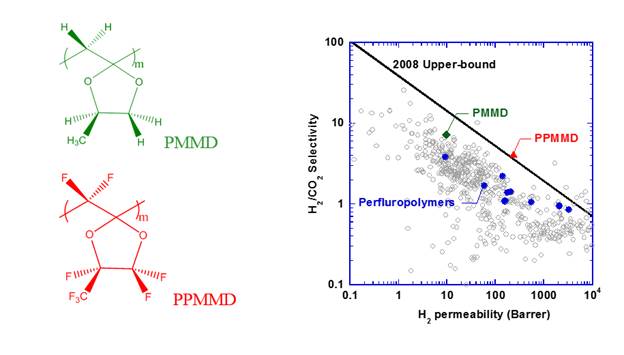
Amorphous glassy perfluoropolymers are attractive for membrane gas separation, such as He/CH4 and CO2/CH4 separation. These perfluoropolymers often have pendant rings to suppress crystallinity and achieve high free volume and thus high gas permeability. However, their applications are hampered by the high cost due to the difficulty in synthesis. We hypothesize that the pendant rings can be incorporated in hydrocarbon polymers to achieve similarly superior gas separation properties. In this study, we design and synthesize hydrocarbon polymers with structures similar to perfluoropolymers, aiming to elucidate the effect of pendant rings on gas separation properties. Specifically, we synthesize a perfluoropolymer of poly(perfluoro-4-methyl-2-methylene-1,3-dioxolane) (PPMMD) and its hydrocarbon polymer analogue, poly(4-methyl-2-methylene-1,3-dioxolane) (PMMD). These polymers with pendant rings are thoroughly characterized using FTIR, NMR, GPC, WAXD, TGA and DSC for physical properties such as molecular weight, crystallinity, and glass transition temperature. PPMMD shows a H2 permeability of 236 Barrers and H2/CO2 selectivity of 4.1 at 35 oC, while the PMMD shows a H2 permeability of 9.6 Barrers and H2/CO2 selectivity of 7.3 at 35 oC. Gas sorption results will be described using the dual mode sorption model. A series of poly(cyclic ketene acetals) with structures similar to PMMD are synthesized and characterized for gas separation. This presentation will also discuss the fractional free volume in these polymers and the use of a free volume model to describe the gas transport properties in these hydrocarbon polymers and perfluoropolymer analogs.
See more of this Group/Topical: Separations Division