
The Effect of New Nanocomposites on Fluidity of Waxy Crude Oil in Low Temperature
ABSTRACT: Improving the fluidity of waxy crude oil through different pour point depressants (PPDs) at low temperature is of great operable and economic interest. Various new PPDs have made great progress in the research of this problem with different mechanisms. In this work, a new nanocomposite (NPPD-1) has been developed based on melt blending of organically modified montmorillonite and ethylene/vinyl acetate copolymers (EVA). The microscopic and macroscopic properties of waxy model oil, with and without new nanocomposite were investigated through X-ary diffraction (Figure1), polarizing microscope, rheometer, and differential scanning calorimeter. Compared to conventional EVA, the model oil with adding nanocomposite presents a decreasing trend with increasing dose in diffraction intensity and interplanar spacing, which exits great difference to EVA. It is noted that the three-dimensional network structure is not conducive because of the lattice parameters of wax crystals changed, which weakens the interaction of each other, so that there are less likely to form large crystals and remarkably improves the low temperature fluidity of waxy oil. Moreover, the rheological parameters demonstrate that doped nanocomposite can reduce the gel point, depress yield stress and viscosity more significantly than EVA (Figure2). The morphology of the wax crystals observed by polarizing microscope shows fewer wax crystals and dispersed finely in doped oil. These conclusions make it possible for us to provide a theoretical basis that the interaction mechanism between paraffin and nanocomposites including nucleation, co-crystallization, adsorption and solubility.
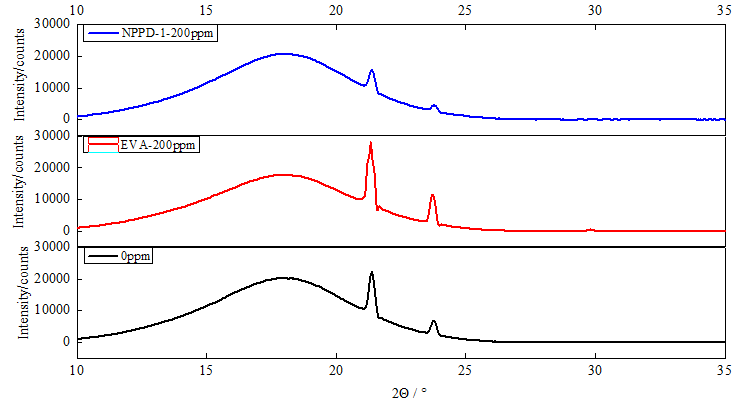
Figure 1. The XRD curves of doped/undoped oil with PPDs
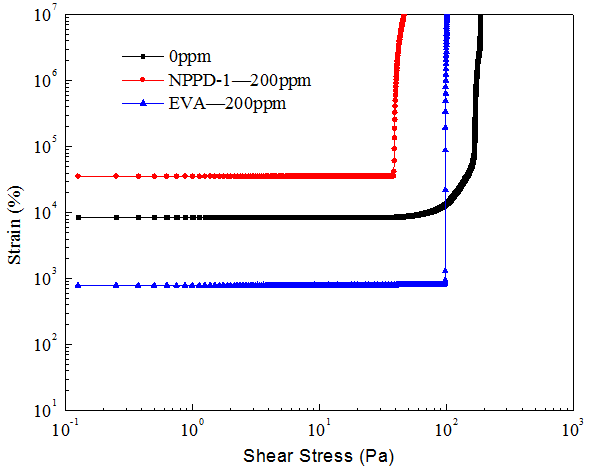
Figure 2. Yield curves of undoped/oped oil with PPDs
See more of this Group/Topical: Fuels and Petrochemicals Division