
An Abstract Submission to 2017 AICHE Meeting
Session: Process Intensification By Enhanced Heat and Mass Transfer
Topical Area: Process Intensification
Process Intensified and Direct Production of Gasoline from Syngas
Xinquan Chenga, William R. Yantz Jr.a, and Bruce J. Tatarchuka, b,*
a Center for Microfibrous Materials Manufacturing, Department of Chemical Engineering, 212 Ross Hall, Auburn University, AL 36849
b IntraMicron Inc., 368 Industry Dr., Auburn, AL 36832, USA
* Corresponding author. Tel.: +1 334 844 2023; fax: +1 334 844 2065; E-mail address: Tatarbj@auburn.edu
Abstract
The increasing demand for liquid fuels draw people’s attentions to the synthetic fuels. Currently, there are mainly two approaches to synthesize liquid fuels from syngas. One is Fischer-Tropsch synthesis (FTS) and another one is syngas-to-methanol first and followed up with methanol-to-gasoline (MTG). Those two approaches are well-known techniques for converting syngas to liquid fuels. However, FTS process produces a broad spectrum of products, which requires complex and expensive subsequent processes to upgrade the initial products in order to meet liquid fuel specifications. The MTG approach is a multiple step process. Typically, in the first reactor syngas is converted to methanol, and followed with methanol dehydration reactor to produce the intermediate product dimethoxyethane (DME), and then DME successively converted to hydrocarbons in the reactor packed with zeolite. It must be noticed that all those reactions are highly exothermic reactions, which producing extremely amount of heat during the reaction processes. Therefore, the reaction thermal management is always a big issue for syngas to liquid fuels.
Here, we present a single reactor system to directly convert syngas-to-gasoline (STG) by using a novel catalyst structure called Microfibrous Entrapped Catalyst (MFEC) structure. The MFEC structure was developed by our group, which is a catalyst network supported by micron-sized metal fibers with high thermal conductivity. By supporting small catalyst particles into a high voidage matrix of microfibers the catalyst is suitable for fixed bed applications without severe pressure drop or bed channeling encountered in small particle packed beds. Previous efforts on this unique catalyst structure have shown significant enhancement in intra-bed heat transfer and mass transfer.[1-4] Basically, we packed a large tubular reactor (34.0 mm I.D.) in three zones by using Cu MFEC. As we can see from Figure 1, the first zone (Zone-1) is a mixed catalyst zone for the production of DME from syngas. The second zone (Zone-2) is a relative inert zone mainly used to separate Zone-1 from Zone-3 since those two zones have different temperature. In order to convert all the unreacted methanol from Zone-1, we packed γ-Al2O3 in Zone-2 as a methanol dehydration catalyst. The third zone (Zone-3) is a zeolite zone packed with ZSM-5 to convert the DME to gasoline. This kind of multi-zone reactor design can separate the zeolite from the methanol synthesis catalyst, because the proximity of those two catalyst components is crucial factor for the product selectivity of STG process.[5] If those two components are close to each other, the lower olefins, which are the essential intermediates from methanol to aromatics, diffuse from the zeolite to the methanol synthesis catalyst, where they are easily hydrogenated to lower paraffins. It turns out that most of the products are short chain paraffins.[6]
However, with this simple multi-zone reactor design, the olefinic intermediates are preserved for subsequently oligomerization reactions. Under a typical reaction conditions (P=30 atm, GHSV=1000 h-1, H2:CO=1:1), the C5 – C10 hydrocarbon selectivity can reach 39.0 wt% with a relative high CO conversion (73.2 %). In addition, the Cu MFEC structure demonstrated a very low radial temperature gradient (around 5 ºC) for a 34.0 mm I.D. reactor and insignificant amount of pressure drop. While with the same test conditions, the comparative packed bed reached a very high radial temperature gradient (around 140 ºC) and significant amount of pressure drop. Considering these attributes and advantages, the Cu MFEC multi-zone reactor system is a very efficient process intensification technique for the direct production of gasoline from syngas.
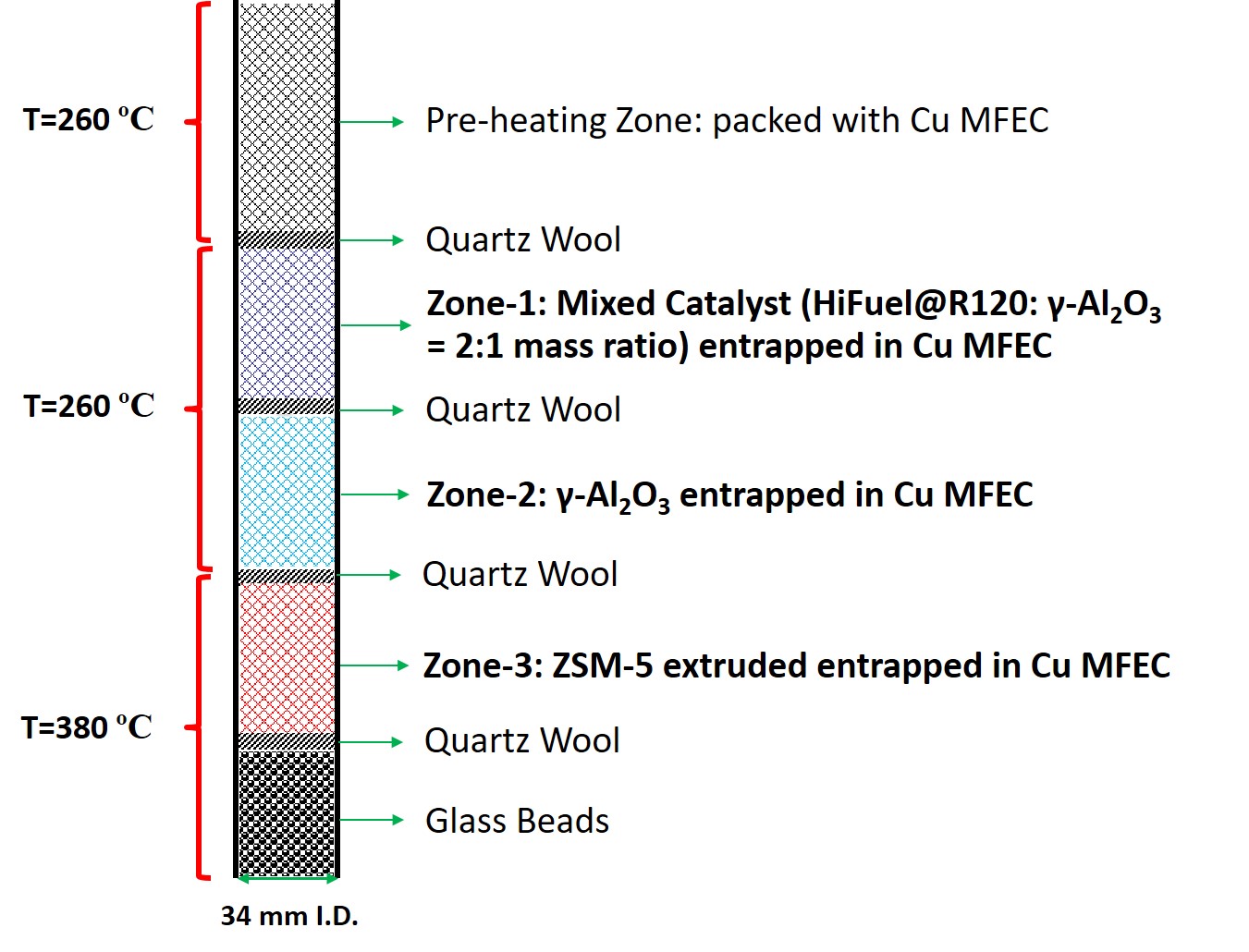
Figure 1. The STG reactor design (all the catalysts particles entrapped in Cu MFEC in Zone-1, Zone-2, and Zone-3 are in 60 – 80 mesh)
References:
[1] M. Sheng, H.Y. Yang, D.R. Cahela, B.J. Tatarchuk, J. Catal. 281 (2011) 254-262.
[2] M. Sheng, H.Y. Yang, D.R. Cahela, W.R. Yantz Jr., C.F. Gonzalez, B.J. Tatarchuk, Appl. Catal. A-Gen. 445-446 (2012) 143-152.
[3] M. Sheng, D.R. Cahela, H.Y. Yang, C.F. Gonzalez, W.R. Yantz Jr., D.K. Harris, B.J. Tatarchuk, Int. J. Heat Mass Tran. 56 (2012) 10-19.
[4] X.Q. Cheng, H.Y. Yang, B.J. Tatarchuk, Catal. Today 273 (2016) 62-71.
[5] S. Sartipi, M. Makkee, F. Kapteijn, J. Gascon, Catal. Sci. Technol. 4 (2014) 893-907.
[6] K. Fujimoto, H. Saima, H. Tominaga, J. Catal. 94, (1985) 16-23.
See more of this Group/Topical: Process Development Division