
Hydrogen Sulfide Donor Micelles: Synthesis, Characterization and Therapeutic Potential
Urara Hasegawa, André J. van der Vlies, Jerry J.Y. Chen, Tomoka Takatani-Nakase, Ikuhiko Nakase
Hydrogen sulfide (H2S) is produced in the human body and serves as a gaseous signal-transmitter molecule that regulates inflammation, relaxes vascular smooth muscles, promotes angiogenesis and mediates neurotransmission. However, due to the difficulty in handling H2S, its therapeutic use has not been well explored. Therefore, development of H2S delivery technologies has attracted growing attention. One common approach is to use H2S donor compounds such as anethole dithiolethione (ADT) derivatives which generate H2S by the interaction with intracellular enzymes. However, this approach suffers from uncontrolled gas generation which limits their applications.
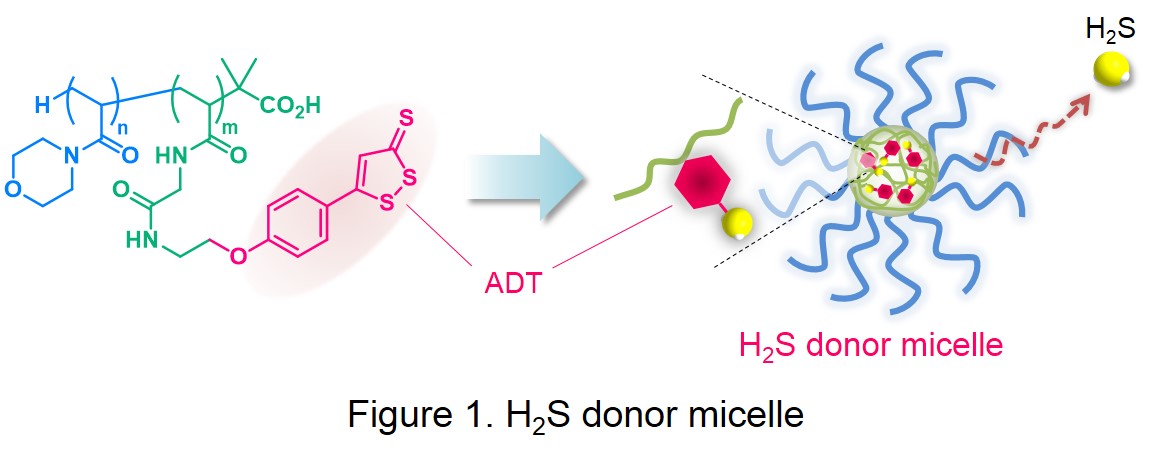
To address this issue, we developed nano-sized gas donors based on polymeric micelles (H2S donor micelles, Figure 1) which enable sustained H2S generation under physiological conditions. In this presentation, we report the design and synthesis of polymeric micelles containing anethole dithiolethione (ADT) moieties. The micelles were prepared from amphiphilic diblock copolymers consisting of a hydrophilic segment and a hydrophobic segment bearing ADT moieties. The micelles generated H2S slowly and continuously for sustained periods of time compared to the small H2S donor compound ADT. Since the disruption of the micelles by adding a surfactant increased the rate of gas generation, the micellar structure seems to be a key to successful control of gas generation. Furthermore, the micelles showed various biological effects including pro-angiogenic and anti-apoptotic effects in in vitro cell culture assays as well as the chicken chorioallantoic membrane (CAM) model.
References
1. U. Hasegawa, A. J. van der Vlies, Bioconjugate Chem., 25 (2014) 1290-1300.
2. U. Hasegawa, A. J. van der Vlies, Med. Chem.Comm., 6 (2015) 273-276.
See more of this Group/Topical: Materials Engineering and Sciences Division