
The current state-of-the-art pipeline chemical transport and processing plants operational improvement
lies in the fundamental understanding and exploration of large and complex data sets. The real-time
gathering of pipeline process information (PI) data at present time generates an extensive database with a
large potential in continuous monitoring, maintenance, hazardous prevention and operational
improvements. To design and operate complex pipeline processes more safely and optimally, we report on
recent automation methodologies for the identification, analysis, and control of risks in process
systems using real-time hybrid intelligent systems which include large databases acquired from
swim-bot (in-home developed passively driven, in-pipe monitoring system recording acoustic and
other signals for leak and various aberrations within pipelines), see Fig.1. The publications of
Mirats reported and Chatzigeorgiou [3, 4, 5, 6, 7, 8] paved the path for the modelling of
in-pipe leak detection devices and the identification algorithms for leak detection, which are
currently the state-of-the-art designs of a water distribution networks leak detector. Contrary to
the water leak detection systems, we consider a pipeline leakage detection based on acoustic
technology [1, 2]. We explore various approaches for the integration of process monitoring, data
reconciliation, fault diagnosis, and supervisory control tasks into a single unified real-time framework.
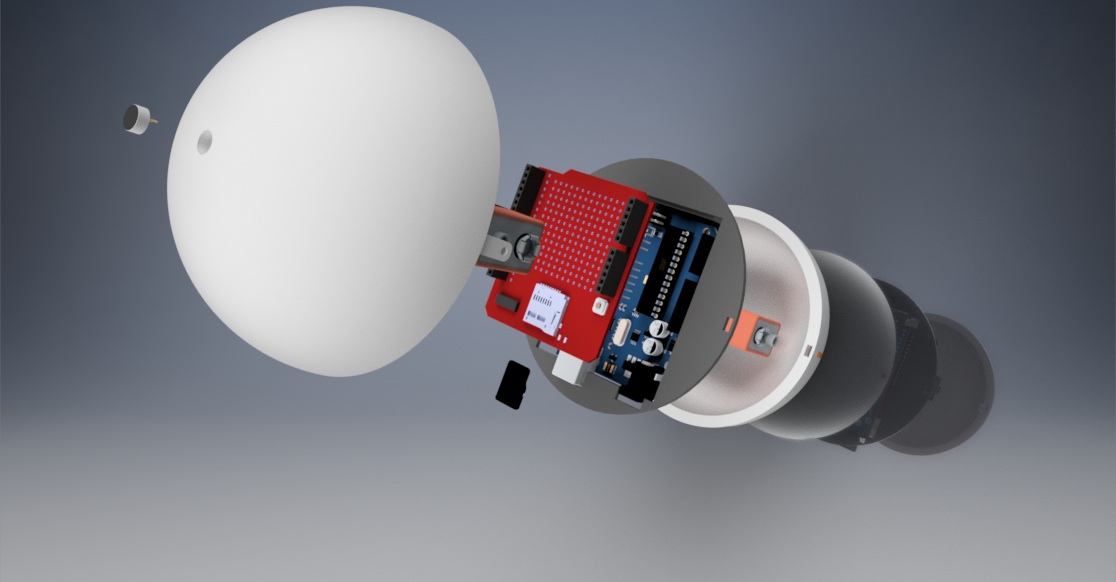
Figure 1: Schematic of the assembly of the swim-bot
with its components
(Omni electric microphone, microcontroller - Arduino,
9V-alkaline batteries, MicroSD, GPS sensor).
The big data analysis relays on notion of continuous inspection of entire pipeline system by
employment of swim-bot robot. In particular, our ability to reach and inspect every segment of pipeline
system provides an advantage compered to the operating systems where measurements can not be taken.
We report on develop swim-bot and complementary software platform which will utilize a large scale of
recorded (monitoring) data to provide an insight into pipeline conditions, scheduled maintenance, risk
analysis and pipeline integrity. [1] Q. Xu, L. Zhang and W. Liang, “Acoustic detection technology for gas pipeline leakage”, Process Safety and Environmental Protection, vol. 91, (2013), pp. 253-261. [2] Liang Wei, Zhang Laibin, Xu Qingqing, Yan Chunying, “Gas pipeline leakage detection based on acoustic technology”, Engineering Failure Analysis, 31 (2013) 1-7. [3] J. M. Mirats Tur and W. Garthwaite, “Robotic devices for water main in-pipe inspection: A survey”, Journal of Field Robotics, 27(4) (2010) 491-508. [4] D. Chatzigeorgiou, K. Youcef-Toumi and R. Ben-Mansour, “Design of a novel in-pipe reliable leak detector”, IEEE/ASME Journal on Mechatronics, 20 (2) (2014) 824-833. [5] D. Chatzigeorgiou, Y. Wu and K. Youcef-Toumi, “Reliable sensing of leaks in pipelines”, ASME Dynamic Systems and Controls Conference (DSCC), 2013. [6] D. Chatzigeorgiou, K. Youcef-Toumi and R. Ben-Mansour, “Modeling and analysis of an in-pipe robotic leak detector”, IEEE International Conference on Robotics and Automation (ICRA), 2014. [7] D. Chatzigeorgiou, K. Youcef-Toumi and R. Ben-Mansour, “Identification & Estimation Algorithms for In-Pipe Leak Detection”, American Control Conference, 2014. [8] R. Ben-Mansour, K. A. Suara and K. Youcef-Toumi, “Determination of Important Flow Characteristics for Leak Detection in Water Pipelines-Networks”, Computational Thermal Sciences, 5(2) (2013) 143-151.
In particular, we report on development of a robotic inspection device capable of carrying sensors along
the pipeline, evaluating the integrity of the pipe walls, getting close to the leak position, and pinpointing
the exact location as well as the magnitude of the defects. The sound data associated with the pipe
integrity are recorded with microphone and loaded on microSD card recorded information associated with
it measurements gathered by the IMU (inertial Measurement Unit). The large data post-processing of
IMU unit recordings are filtered and smoothed in order to obtain relevant prediction and
localization of the leak localization. The precision required for localization of the leak is of
paramount importance since the large amount of data and measurement induced noise needs to be
processed in the leak localization process. We will demonstrate with actual experimental and
data processing settings ability of swim-bot system to identify leaking location with desired
precision.
See more of this Group/Topical: Computing and Systems Technology Division