
Renewable energy sources such as solar and wind suffer from an intermittent
power output, making energy storage a key element in future energy
infrastructure. Fuels offer both high energy densities and efficient transport compared
to other energy storage alternatives. One energy storage solution is water
electrolysis. However, the generated hydrogen is incompatible with the global
fuel infrastructure, inhibiting its implementation as an energy vector. Storing
hydrogen on carrier atoms provides a safe and convenient way to utilize and
transport renewable energies. While carbon–based fuels are commonly suggested, using
nitrogen as a hydrogen carrier can potentially offer a superior option. In this
talk we will present the culmination of several studies on nitrogen-based
fuels. Firstly, an analysis comparing the energy-based efficiency of several
carbon-based synthetic fuels to their nitrogen-based counterparts will be presented.
Secondly, the effect of the equivalence ratio on the thermal autoignition of a
non-carbon nitrogen-based fuel will be shown. Thirdly, the effect of Ru/Pt/Al2O3
catalysts used for effluent gas treatment of a low-carbon nitrogen-based fuel
will be discussed. To evaluate the feasibility of nitrogen-based fuels, seven carbon-
and nitrogen-based synthetic fuels were analyzed on a power-to-fuel-to-power (PFP)
basis. Methane, methanol and dimethyl ether were compared to ammonia, ammonium
hydroxide with urea (AHU), ammonium hydroxide with ammonium nitrate (AAN) and
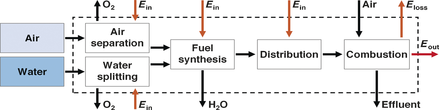
urea with ammonium nitrate (UAN). This analysis took into account the energy
costs of air separation, water splitting, fuel synthesis and distribution (Fig.
1). Both possible sources of carbon dioxide (atmospheric and flue gas) were
considered in this investigation. The results of this analysis indicate that
ammonia is the most efficient candidate. This study demonstrates the
feasibility of nitrogen-based synthetic fuel economy.
Figure 1. Principal material and energy balance for fuel analysis
by PFP An aqueous solution of ammonium hydroxide and ammonium nitrate
(AAN) fuel includes a reducer and a net oxidizer. Therefore, the fuel equivalence
ratio (ϕ) can be defined as the ratio of ammonia to nitric acid divided by
the stoichiometric ratio of the two. The effect of ϕ on the thermal autoignition of AAN was studied using a combined DTA/DBA
(differential thermal/barometric analysis) system. Results indicated an
increase in the autoignition temperature (AIT) with ϕ. Gas-phase kinetics simulations, used to investigate the cause for
this behavior, indicated that nitric acid decomposition promotes the thermal autoignition.
On the other hand, reduction of NO2 and NO3 to nitric
oxide inhibited the ignition. This was due to the role of NO2 and NO3
radicals in reactions producing amidogen from ammonia. The potential for selecting
efficient catalysts for future use in AAN's catalytic ignition using this data will
be discussed. Continuous combustion of UAN yields primarily steam, nitrogen and
carbon dioxide. However, small amounts of pollutants such as carbon monoxide,
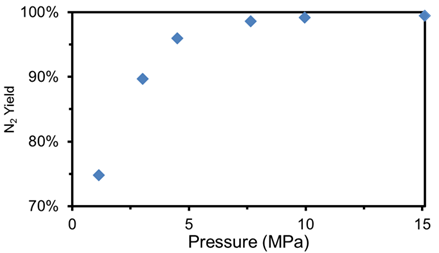
ammonia, nitrous oxide and NOx are present in UAN's effluent. Increasing
the system pressure was previously found to reduce pollutant levels and
increase the combustion product yield (Fig. 2). However, high pressures exceeding
15 MPa were required to achieve this effect.
Figure 2. The nitrogen yield as a function of system pressure Catalysts can be used to reduce the concentrations of these
pollutants at lower pressure values. Platinum, ruthenium and bimetallic Pt/Ru
catalysts on an Al2O3 support were prepared and tested at
pressures of 1 – 7.5 MPa and temperatures of 250 – 500ºC. Outlet concentrations were measured using online FTIR analysis. While
pure platinum increased the ammonia effluent by a factor of three at 5 MPa and temperatures
up to 300ºC, it
eliminated all other pollutants. At higher temperatures the ammonia generation
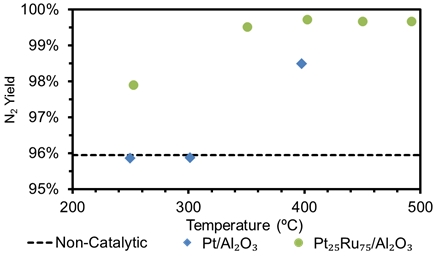
ceased, but nitrous oxide was generated instead. The N2 yield was 95.9%
– 98.5%
in the 250 – 400oC range as shown in Fig. 3.
Figure 3. The nitrogen yield as a function of temperature for the
Pt25Ru75/Al2O3 at 5 MPa and
non-catalytic systems With pure ruthenium and bimetallic Pt/Ru at temperatures above 350ºC and 300ºC,
respectively, all pollutants but N2O were eliminated at 5 MPa.
However, nitrous oxide was generated in low amounts at these high temperatures.
Results indicated that at 5 MPa Pt/Ru at an atomic
ratio of 25:75 was capable of increasing the N2 yield from 96% to
99.7% (Fig. 3) and the CO2 yield from 99% to 100%. The improved N2
yield of the Ru/Pt catalysts in Figure 3 demonstrates its advantage over the
pure Pt alternative. Comparison of these results to current regulatory
standards will be discussed.
See more of this Group/Topical: Topical Conference: NH3 Energy+ - Enabling Optimized, Sustainable Energy and Agriculture