
Study of residence time distribution in a Taylor-Couette reactor
Haoyu Wang*, Anh Phan, Vladimir Zivkovic, Kamelia Boodhoo
Chemical Engineering and Advanced Materials, Merz Court, Newcastle University NE1 7RU Newcastle upon Tyne, United Kingdom.
*Haoyu.Wang@newcastle.ac.uk
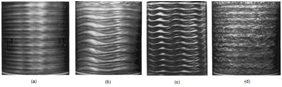
The flow between the gap of two differentially rotating concentric cylinders is called Taylor-Couette (TC) flow. TC flow exhibits different flow regimes (Taylor vortex flow, Wavy vortex flow, Modulated wavy vortex flow, Turbulent Taylor vortex flow) as the rotational speed of the cylinder is increased (Figure 1). Residence time distribution (RTD) is an important parameter in reactor design which characterizes the flow and mixing behavior of reaction components, thereby influencing the selectivity in chemical reactions. Very few studies have been reported on RTD characterization of TC flow, focusing primarily on limited axial flow rates and rotational speed ranges where the Taylor vortex flow regime is achieved1,2. The present work aims to evaluate RTD across the whole spectrum of possible flow regimes in TC flow in order to provide a more comprehensive understanding of the mixing behavior inside a TC reactor.
|
|
Figure 1. Example flow regimes of Taylor-Couette flow: (a) Taylor vortex flow (b) Wavy vortex flow (c) Modulated wavy vortex flow (d) Turbulent Taylor vortex flow 3
| Figure 2. Schematic of TC reactor. |
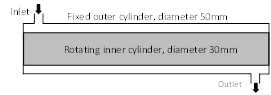
The experimental facility consists of two horizontally placed concentric cylinders of 300 mm in length and a gap of 10 mm between the cylinders (Figure 2). The outer Perspex cylinder (50 mm in diameter) is fixed and the inner cylinder (30 mm diameter and made of 316 SS) rotates. The rotating speed of the inner cylinder ranges from 0 to 1500 rpm. The working fluid, a mixture of water and glycerol, is injected into one end of the device at different flow rates of up to 500 ml/min. Pulse injection of the tracer KCI solution at the inlet is achieved by a syringe pump. An E61M014 conductivity probe of 4 mm in diameter and 103 mm in length that connects to a CDM210 conductivity meter is placed at the outlet of the reactor for the measurement of conductivity of the working fluid. The conductivity can be used to obtain the residence time distribution. Initial experiments using pure de-ionized water indicate that the RTD profiles vary between different flow regimes at the same axial flow rate highlighting the mixing behavior in a TC reactor can alter from near-plug flow reactor to mixed flow behavior as rotational speed increases. Further RTD results will be presented and discussed in the context of the flow regime generated in the TC device.
Acknowledgements
The authors would like to thank the European Union’s Horizon 2020 research and innovation program for financial supports (grant agreement No 680565).
References
1. Kataoka, K., Doi, H., Kongo, T. and Futagawa, M. (1975) 'Ideal Plug-Flow Properties of Taylor Vortex Flow', Journal of Chemical Engineering of Japan, 8(6), 472-476.
2. Pudjiono, P.I., Tavare, N.S., Garside, J. and Nigam, K.D.P. (1992) 'Residence time distribution from a continuous Couette flow device', The Chemical Engineering Journal, 48(2), 101-110.
3. Fenstermacher, P.R., Swinney, H.L., Benson, S.V. and Gollub, J.P. (1979) 'Bifurcations to periodic, quasiperiodi, and chaotic regimes in rotating and convecting fluids', Annals of the New York Academy of Sciences, 316(1), 652-666.
See more of this Group/Topical: North American Mixing Forum