
Solar thermochemical water splitting cycles are considered as one of the most promising options for hydrogen production. In a long list of solar thermochemical water splitting cycles, the sulfur-iodine cycle and its variation the hybrid sulfur cycle are more appealing as the required operating temperatures are lower as compared to other thermochemical cycles. For both cycles, the most energy intensive step is the dissociation of SO3 into SO2 and O2, which is possible only under catalytic conditions. As sulfation poisoning is a major concern related to such reactions, simply the noble metal catalysts were observed to be active towards the endothermic dissociation of SO3. Although, the noble metal catalysts are attractive for such reactions, they are less preferable due to the limited availability and high cost. To overcome this issue, we propose a solar driven metal oxide – metal sulfate (MO-MS) based water-splitting cycle for the production of hydrogen. In this study, the thermodynamic and experimental analysis of the MO-MS based water splitting cycle was studied. At first, the computational thermodynamic analysis was performed to identify the required temperatures, pressures, and inert gas flowrates to operated MO-MS water splitting cycle. This analysis also helps to find the efficiency of this cycle in terms of the conversion of solar energy into hydrogen. After performing the computational thermodynamic analysis, the MO-MS based water splitting cycle was experimentally investigated using a high temperature TGA and a packed-bed reactor set-up. Obtained thermodynamic and experimental results will be presented and compared with other thermochemical cycles in detail.
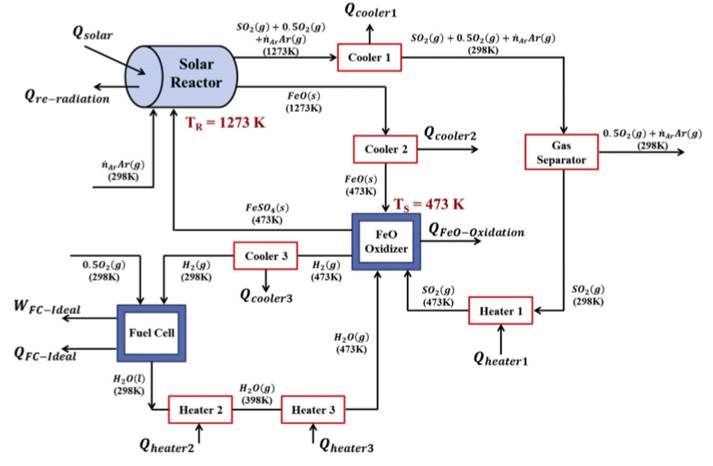
Figure 1: Process flow configuration of iron oxide – iron sulfate water splitting cycle.
See more of this Group/Topical: Topical Conference: Innovations of Green Process Engineering for Sustainable Energy and Environment