
We describe the techno-economic background and the R&D work scheduled for the ARPA-E project :
“Direct Ammonia Fuel Cells ( DAFCs) for Transportation Applications”
which is about to start under the REFUEL program. The project is led by Shimshon Gottesfeld &Yushan Yan, University of Delaware, Jia Wang & Radoslav Adzic, Brookhaven National Laboratory, Chulsung Bae, Rensselaer Polytechnic Instituteand Bamdad Bahar, Xergy Inc. The multidisciplinary R&D work scheduled will cover the fields of advanced membrane and electrocatalyst development, MEA development and fabrication and stack engineering. The latter two activities will be supported by work at POCellTech, with Miles Page as lead.
The Project Vision is creation of a high power density, direct ammonia fuel cell suitable for transportation applications , using a hydroxide exchange membrane electrolyte and operating the cell near 100 degC. A practical ammonia fuel cell should enable use of the lowest cost, carbon-neutral liquid fuel for clean, long-range transportation.
A detailed techno-economic evaluation of carbon free and carbon neutral fuels , made in the preparatory phase of this Project, revealed that the combined cost of fuel storage and fuel transport is the lowest for liquid ammonia. This is a direct result of the high energy density and the liquid form of the fuel under conditions very close to ambient .
The choice of a polymer electrolyte fuel cell for operation in direct oxidation mode with ammonia as fuel, has been made in light of the inherent advantages of this type of low temperature fuel cells in powering passenger vehicles which typically require a number of stop-restart cycles per day. Making such choice, requires, however, to answer successfully the challenge of the low rate of anodic oxidation of ammonia, reported to date for DAFCs operating at low cell temperatures. It was concluded by our team, that operation near or somewhat above 100 degC, could allow, by use of advanced anode electrocatalysts, to achieve the power density levels required for transport applications. This strategy requires, however, OH- ion conducting ionomers which are stable near , or somewhat above 100 degC , whereas, to date, stability of this type membrane above 70 decC has not been established. Hence, the targeting of high power density DAFCs operating around 100 degC, requires successful combined development of advanced electrocatalysts and advanced hydroxide-conducting membranes, with the catalyst enabling operation at cell temperature widely considered to date as too low for direct anodic oxidation of ammonia and, the advanced membrane exhibiting good stability near 100 degC.
Early tests performed by us with some well chosen binary-metal anode catalysts and using two types of OH- ion conducting membranes, resulted in DAFC power levels around 90 degC that were more than an order of magnitude higher than reported to date. Results of voltage vs. current density and, power density vs. current density, are shown below for a DAFC operating at 95 degC with vendor-supplied hydroxide conducting membrane , a bimetallic anode catalyst and a silver catalyzed cathode.
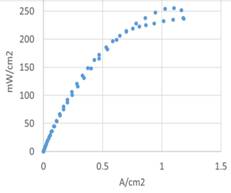
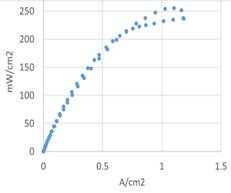
The performance shown here for a polymer electrolyte DAFC operating at such temperature, is the result of not only the quality of the cayst and the membrane, but, to significant degree, the quality of the membrane/electrode assemblies prepared and, last but not least, optimized gas flow rates and inlet RH levels.
See more of this Group/Topical: Topical Conference: NH3 Energy+ - Enabling Optimized, Sustainable Energy and Agriculture