
The
fluctuating nature of renewable energy sources is becoming a limiting factor in
their widespread utilization. Energy storage solutions must be developed to
overcome this issue. Chemical fuels are considered to be a promising solution to
this problem. We are studying the implementation of nitrogen-based fuels for
this purpose. An aqueous solution of ammonium nitrate and ammonium hydroxide
(AAN) is suggested as a carbon-free nitrogen-based synthetic monofuel. This
solution may serve as a renewable nitrogen-based synthetic hydrogen carrier
since it is safe to store, transport and utilize. Since ammonium hydroxide (AH)
and ammonium nitrate (AN) act as reducer and net oxidizer, they can combust
without the need for an external oxidizer (i.e. O2/Air). The amount
of water in this solution greatly affects the saturation point and hence the
sensitivity to re-crystallization at low temperatures which in turn affects the
storage conditions. Thus, the effect of AAN's water content on its thermal
autoignition must be investigated.
Testing
of AAN solutions was performed under a nitrogen atmosphere in a thermal
autoignition system designed per the ASTM G72 standard. Previous tests have
indicated that the addition of diluents such as nitrogen inhibits the thermal
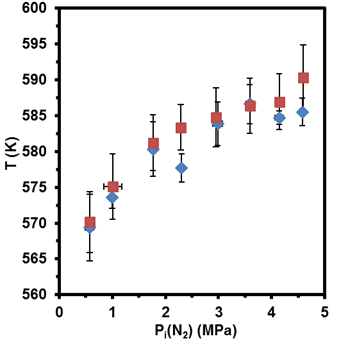
autoignition temperature (AIT) seen in Fig. 1. As shown, the AIT rises from ~
570ºC
to 590ºC
as the initial nitrogen pressure increases from 0.5 MPa to 4.5 MPa.
Figure
1. Thermal autoignition temperatures as a function of the initial N2
pressure. Data points identified via differential thermal and barometric curves
are marked ® and¾,
respectively.
The
effect of AAN's water content on its ignition was explored at a heating rate of
5 K min-1. The autoignition onset pressures and temperatures were
compared at water weight fractions of 25% – 45%. As the water content in the
fuel increased, the onset pressures and temperatures of the ignition rose as
well due to the heat sink effect of the inert water. To explore the effect of
the water on the gas-phase kinetics leading to the thermal autoignition, kinetic
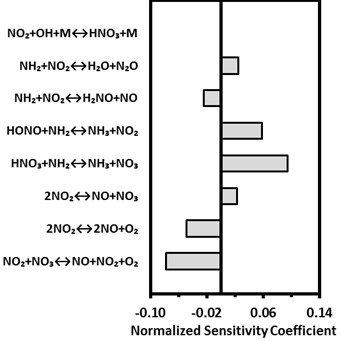
simulations were performed and validated relative to the experimental data. Sensitivity
analysis of the simulation results identified amidogen generation from ammonia
to be the rate-limiting step in AAN's thermal autoignition at a water content
of 28%wt. (see Fig. 2).
Figure
2. The normalized sensitivity coefficients relative to temperature for 28%wt
water at 5% ammonia conversion. Negative and positive values indicate either an
increase or a decrease in temperature, respectively.
The
effect of AAN's water content on its autoignition temperature, and the results
of the rate-of-production and sensitivity analyses will be presented and
discussed.
See more of this Group/Topical: Topical Conference: NH3 Energy+ - Enabling Optimized, Sustainable Energy and Agriculture