
Ionic liquid pretreatment of lignocellulosic biomass: Effect of biomass composition on pretreatment efficiency
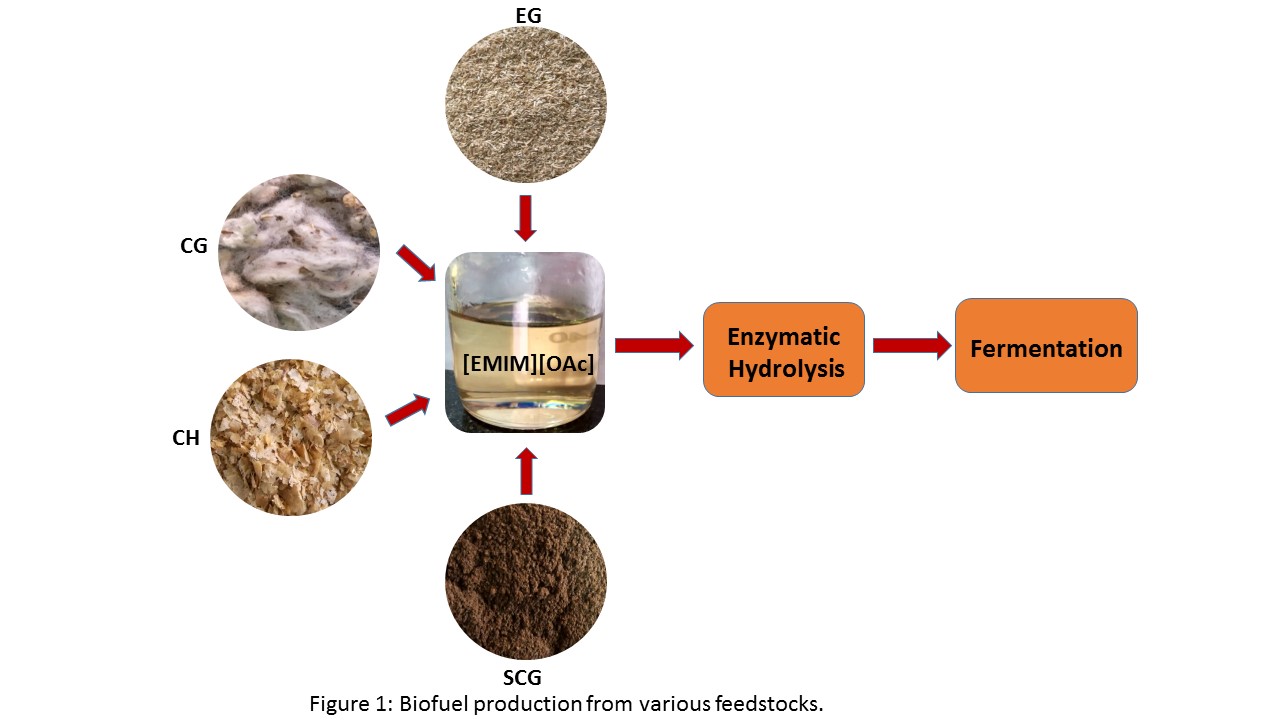
Globally, bio-fuel is becoming an attractive substitute for fossil fuels due to the increasing demand for clean energy and rapidly depleting crude oil reserves. Utilization of non-food biomass has been recently has been preferred because of its non-competitiveness towards food crops and its generation in the huge amount as a waste by-product. For production of biofuel, lignocellulosic biomass waste must be pretreated in order to break down its complex structure. Pretreatment with ionic liquid (IL) 1-ethyl-3-methylimidazolium acetate ([EMIM][OAc]) has been reported to disrupt structure and dissolve biomass. In this study, the performance of [EMIM][OAc] was investigated for dissolution of four different lignocellulosic biomasses (figure 1). The feedstocks chosen in this study were spent coffee grounds (SCGs), coffee husks (CH), Eucalyptus globulus (EG) bark, and cotton gin (CG), which are widely produced as food and industrial waste by-products. These feedstocks significantly differ in their relative composition of cellulose, hemicellulose and lignin. The pretreated biomass was enzymatically hydrolysed by commercial cellulase enzymes and the sugars thus obtained were fermented using wild-type yeast. A comparative analysis of the impact of IL treatment on the feedstocks was carried out, which showed that there was an increase in the digestibility of the pretreated biomass. Highest digestibility was observed in cotton gin, which was the feedstock with the least amount of lignin. The recovery and recycle of the IL was also investigated in this study.
See more of this Group/Topical: Topical Conference: Thermal Deconstruction of Biomass