
allyl-sulfide modified HYDROGELS with switchable properties
as dynamic cellular niches
Tobin Brown, Joseph Grim, Ian Marozas, and Kristi Anseth
Department of Chemical and Biological Engineering and the BioFrontiers Institute
University of Colorado, Boulder, CO, USA 80303
Hydrogels possess a number of properties that render them useful as synthetic extracellular matrices for 3D cell culture and/or cell delivery systems for regenerative medicine; these properties include cytocompatibility, ease of functionalization, and physical properties similar to many soft tissues. Most synthetic hydrogel systems are highly tunable, both in terms of their mechanical and biochemical properties, and when combined with advanced manufacturing methods (e.g., photochemical reactions, 3D printing, microfluidics), experimenters can create hydrogels with gradients, patterned ligands or other hierarchical structures found in native tissues. While the ability to control and manipulate hydrogel properties across many size scales has been powerful, the native extracellular matrix (ECM) is a dynamic environment, particularly during development, wound healing, and disease, and biological and mechanical signals can change dramatically with time. The ability to dynamically tune hydrogel properties can be lost in many synthetic ECM mimics, especially if they are crosslinked and functionalized by irreversible covalent bonds.
In an effort to capture the inconstant nature of native cellular niches, we have investigated hydrogels containing allyl sulfide functionalities. In the presence of photogenerated radicals, allyl sulfides undergo reversible addition and fragmentation. When incorporated as a pendant group within a polymer network, this allows for reversible photopatterning, which we have demonstrated with thiol-containing peptides [1]. More recently, we have expanded this approach to achieve reversible protein immobilization in hydrogels (Figure 1a). Thiolated proteins were covalently tethered to hydrogels through a photoinitiated thiol-ene reaction with the alkene of the allyl sulfide. To release the protein, a subsequent thiol-ene reaction was performed using a small molecule thiol. Importantly, this process is cytocompatible and can be repeated numerous times as the allyl sulfide is regenerated with each thiol-ene reaction. Next, to achieve dynamic control over matrix mechanical properties, allyl sulfides were incorporated directly into the network crosslinks. During photoinitiated radical generation, crosslinks where exchanged with pendant thiols or soluble monofunctional thiols to achieve rapid stress relaxation or photodegradation, respectively. Figure 1b shows temporal regulation of the network viscoelasticity in the presence of photogenerated radicals. During light exposure, pendant thiyl radicals exchange with network allyl sulfides, resulting in deformation under an applied stress. Similarly, soluble monofunctional thiyl radicals can exchange with network allyl sulfides, resulting in rapid photodegradation [2] (Figure 1c). Together, these materials constitute a class of hydrogels with dynamic chemical and mechanical properties, and this presentation include recent progress in using these materials as a dynamic culture platform for regulating the functional properties of human mesenchymal stem cells.
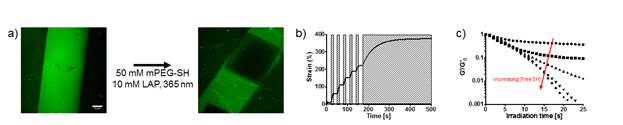
Figure 1: Hydrogels with dynamic biochemical and mechanical properties. a) A full-length protein is first tethered to the hydrogel in a stripe pattern. The protein is then released in defined regions in the presence of soluble thiol and photoinitiator LAP. b) A creep experiment demonstrates light-mediated changes in viscoelasticity. During UV exposure (shaded regions) the gel deforms in response to an applied stress, and the gel reverts to purely elastic behavior when the light is shuttered and when the photoinitiator is consumed. c) Photodegradation in the presence of soluble thiol. Increased concentration of free thiol leads to faster photodegradation.
References –
(1) N. R. Gandavaparu, M. A. Azagarsamy and K.S. Anseth, Advanced Materials, 26, 2521-26 (2014).
(2) T.E. Brown, I.A. Marozas and K.S. Anseth, Advanced Materials, 10.1002/adma.201605001 (2017)
See more of this Group/Topical: Materials Engineering and Sciences Division