
Corey Woodcock, Xiangfei Yu, Yoav Peles1 and Joel Plawsky
Rensselaer Polytechnic Institute; 1University of Central Florida
The Piranha Pin Fin (PPF) microdevice is a heat exchanger engineered to dissipate extreme thermal loads using either dielectric fluids such as HFE7000 or water. Fabrication of the device is CMOS compatible and the first generations of the device have been fashioned from silicon substrates. The PPF operates on the principle that heat transfer would be more efficient if heated fluids could be removed nearly as fast as they are created. This process would keep the driving force as high as possible. Thus the heat exchanger is built as two layers; a primary substrate that dissipates the bulk of the heat and shunts the heated fluids to a booster section that continues to heat the fluid and extends the total surface area of the device. Three generations of devices were fabricated. The first two generations were single-layer systems designed to help understand the operation of the primary layer and optimize the shape and location of the pin fins. The third generation was the first, two-layer system to be fabricated and tested.
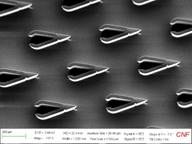
Figure 1 Representative PPF array
Correlations for the heat transfer coefficient, htp, based on the Boiling Number and the Weber Number in the PPF design was developed and validated with Gen II. The discrepancy of heat transfer coefficient between predicted and measured values was within 20%. The ratio of two-phase to single-phase pressure drop was correlated with the Boiling Number (Bo) and the Jakob Number (Ja). The discrepancy of the two-phase multiplier between prediction and experimental measurements were within 12%.
 (1)
The third generation PPF heat sinks were the first series to provide both a primary substrate populated with PPFs, as well as a booster substrate populated with solid micro pin fins. The substrates are micro-aligned and fusion-bonded to provide a full three dimensional (3D) architecture with bulk silicon properties. Experimental results from the Gen III PPF microdevices provide a proof of concept of the true PPF heat sink concept with fluid venting into multiple substrates. At low flowrates (G = 670 [kg/s/m2]) the Gen III PPF heat sink has been shown to dissipate heat loads approaching 1.1 [kW/cm2] at an exit quality of 95%, while at higher flowrates (G = 3,300 [kg/s/m2]) the thermal limit of the heat sink remains unknown due to exceeding the available power supply at >1.4 [kW/cm2].
See more of this Group/Topical: Catalysis and Reaction Engineering Division