
Characterizing Human Embryonic Stem Cells Function With Dielectrophoresis And Flow Cytometry
Tayloria Adams, Clarissa Ro, Shubha Tiwari, and Lisa Flanagan
Neurology Department, University of California, Irvine
Human embryonic stem cells (hESCs) provide great opportunities in stem cell therapeutics because they can differentiate into the three germ layers: ectoderm, mesoderm, and endoderm. More specifically, hESCs can be directed toward human neural stem/progenitor cell (hNSPC) differentiation and used to treat neurological diseases and injuries. Sufficiently characterizing hNSPCÕs functional behavior before using them in transplant therapy is essential to the development of reliable therapeutic treatment options. Having measures that will accurately reflect cell phenotype after transplantation is critical. Currently, the process for cell characterization is challenging due to a lack of biomarkers that provide an adequate picture of hNSPCs specific functions. Therefore, weÕve implemented dielectrophoresis (DEP), a label-free characterization technique that uses nonuniform electric fields, to determine cellsÕ dielectric properties such as membrane capacitance (Cmem). Additionally, hNSPCs were analyzed by flow cytometry to characterize surface protein expression answering the scientific question Òare there correlations between Cmem, measured by DEP, and protein expression?Ó
Three sets of hESC-derived hNSPCs (Shef4-1, Shef4-2, Shef4-3) were derived from passage 6 EZ spheres and established as monolayers before analysis. The Shef4-1, Shef4-2, and Shef4-3 nomenclature indicates that these cells were derived from the same set of EZ spheres but separately differentiated to form hNSPCs, as would be done to generate sufficient numbers of stem cells for therapeutic purposes. Once established as monolayer hNSPC cultures, their cell size, DEP spectra, Cmem, and cell surface protein expression were quantified at a variety of passage numbers to determine lot-to-lot variability or variability over passaging.
Results show that cell diameter varies across lots with Shef4-1 > Shef4-2 > Shef4-3. Similarly, there is variability across lots in the DEP spectra, which is corroborated with Cmem. At early and late passages between 0-100kHz the DEP spectra is shifted right for Shef4-2 as compared to Shef4-1 and Shef4-3 (Figure 1A and 1B). The corresponding Cmem at early and late passages, Figure 1C and 1D, shows that each cell batch is different with statistical significance (one-way ANOVA). Across passages, Shef4-1 and Shef4-2 Cmem gradually decreases and Shef4-3 Cmem fluctuates minimally. Alpha6 and alphaV integrin markers were assessed by flow cytometry for each batch of cells, and the % protein expression was plotted with Cmem, Figure 1E and 1F. For alpha6, there is a strong correlation to Shef4-2 Cmem (R2=0.882), and essentially no correlation to Shef4-3 (R2=0.081). For alphaV, there is a weak correlation for Shef4-2 (R2=0.244), and no correlation for Shef4-3 (R2=0.082). Shef4-1 was not included because alpha6 and alphaV expression was low (less than 14%).
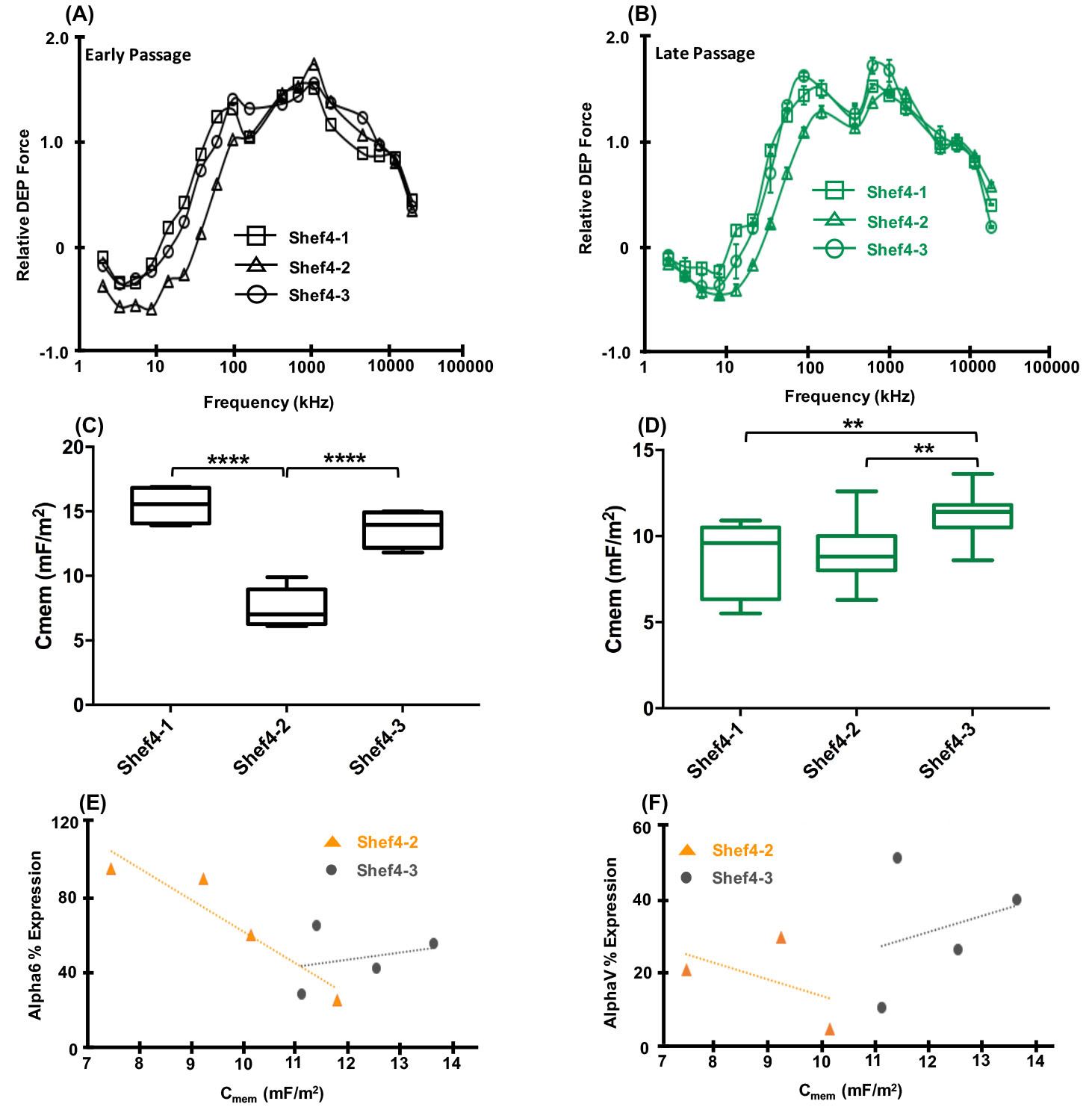
Figure 1. hESC derived hNSPCs were characterized using DEP and flow cytometry. Shef4-1, Shef4-2, and Shef4-3 DEP spectra at (A) early (p4) and (B) late (p6 and p7) passage. Average Cmem for (C) early and (D) late passage Shef4-1, -2, and -3 cells. (E) Alpha6 and (F) alphaV integrin expression with the associating Cmem (passages are matched). One-way ANOVA posthoc Tukey test conducted for multiple comparisons, **p <0.01 and ****p < 0.0001.
Significant lot-to-lot variability exists among hESC-derived hNSPCs, and DEP plus flow cytometry provide a good quantitative assessment of cell phenotype variability. Shef4-2 Cmem correlates well to alpha6 while no correlations were seen with alphaV. Alpha6 and alphaV integrins are important for cell migration and differentiation. Linking integrin expression with DEP measurements provides additional insights to the biological meaning of Cmem to expand beyond the core definition, which is the ability to store charge. Effectively discerning the functional behavior of stem cells before their use in transplants is essential to advance stem cell therapeutics.
See more of this Group/Topical: 2017 Annual Meeting of the AES Electrophoresis Society