
Fundamental research on phase equilibrium of extraction desulfurizaiton of FCC gasoline
Yuhao Zhang, Liang Zhao, Jinsen Gao, Chunming Xu
State Key Laboratory of Heavy Oil Processing, China University of Petroleum (Beijing), Beijing, China, 102249
Due to the increasing awareness of protecting environment, the great demand for ultralow sulfur contents in motor gasoline has become increasingly significant. Nowadays, many technologies have the ability to produce clean gasoline to meet the requirement of sulfur content (<10 ppm). Approaches of desulfurization could be divided into hydrodesulfurizaiton and non-hydrodesulfurization. Wherein, the hydrodesulfurization processes were well developed and widely applied in the whole world, such as ISAL, Octgain, Prim-G+, SCAN Fining, and CDTech [1-5] processes. Part of non-hydrodesulfurization processes were also gathered much attention, such as adsorptive desulfurization, extraction desulfurization, oxidative desulfurization, and biological desulfurization[6-12]. Wherein, extraction desulfurization process was well developed because advantages of variety of solvents, high selectivity, low operating price, low energy consumption, eco-friendly, et al. Commonly, it was divided into solvent extraction[7,13] and extractive distillation[14-17] depending on the mechanism, such as Shen reported a gasoline desulfurization using solvent extraction[7] and GTC-BTX Plus technology[14] by extractive distillation. In spite of the theory of these two methods were different, the interaction of phase equilibrium between solvents and key components of FCC gasoline still plays a significant role to impact the effect of separation which could be express through liquid-liquid equilibrium or vapor-liquid equilibrium experiment.
In this research, the composition of different distillation fractions of FCC gasoline were analyzed and the feedstock of solvent extraction and extractive distillation were selected carefully. And then, particular investigated the properties of different kinds of single solvents using liquid-liquid equilibrium and vapor-liquid equilibrium experiment to found the fundamental of extraction desulfurization of FCC gasoline. Furthermore, an optimal compound solvent were selected using phase equilibrium experiment.
In conclusion, the effect of separation performance of different solvents were studied in several ways. Sulfolane shown a great interaction of aromatics and sulfides. Furthermore, a best compound solvent was determined which the sulfur separation rate was 75 % and has the ability to separate C6~C8 olefins into the raffinate containing a small quantity of aromatics. The results were shown in Figure 1 to Figure 3.

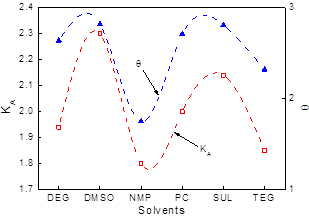
Figure 1 Selectivity of olefins and aromatics using different single solvents
kA shows the ability to dissolve aromatics; θ shows the ability of selectivity between aromatics and olefins

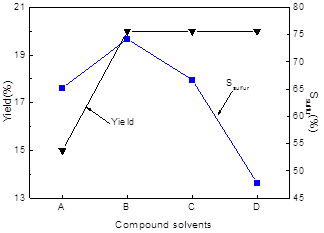
Figure 2 Sulfur separation rate and raffinate yield using compound solvents

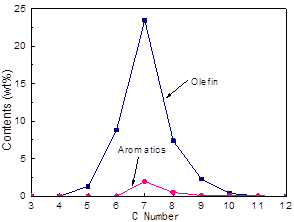
Figure 3 Olefin and aromatics distribution in raffinate using optimal compound solvent
Acknowledgement
This research is supported by National Natural Science Foundation of China (Grants 21336011, 21476260 and 21236009). And also supported by the Science Foundation of China University of Petroleum-Beijing (Grants 2462015YQ0311).
References
[1] Martinez, N.P. Meeting gasoline pool sulfur and octane targets with ISAL process. NPRA Annual Meeting, 2000, San Antonio.
[2] Shih, S. S., Owens, P. J., Palit, S. Mobil’s Octgain Process: FCC gasoline desulfurization reaches a new performance level. NPRA Annual meeting. 1999, San Antonio.
[3] Baco, F., Debuisschert, Q. Prime-G+ process, desulfurization of FCC gasoline with minimized octane loss. Fifth International Conference on Refinery Processing, AIChE 2002 Spring National Meeting. 2002, New Orleans.
[4] Kaufmann, T., Kaldor, A., Stuntz G. Catalysis science and technology for cleaner transportation fuels. Catalysis Today. 2000, 62 (1), 77-90.
[5] Babich, I.V., Moulijn, J.A.. Science and technology of novel processes for deep desulfurization of oil refinery streams: a review. Fuel. 2003, 82 (6), 607-631.
[6] Khare et al. Transport desulfurization process utilizing a sulfur sorbent that is both fluidizable and circulatable and a method of making such sulfur sorbent. 2002, US 5914292.
[7] Haitao Shen, Benxian Shen, Hao Ling. Desulfurization of fluid catalytic cracking gasoline by extractive distillation coupled with hydrodesulfurization of heavy fraction. Energy & Fuels. 2013, 27, 5153-5160.
[8] Ke Ming, Zhou Aiguo, Zhao Zhensheng, Jiang Qingzhe, Song Zhaozheng. Alkylation of thiophenic sulfur technology in the production of clean fuel. Chemical Industry and Engineering Progress. 2006, 25 (4), 357-361.
[9] Qiu Shi, Wu Liguang, Shi Guozhong, et al. Preparation and pervaporation property of chitosan membrane with functionalized multiwalled carbon nanotubes. Ind Eng Chem Res. 2010, 49 (22), 11667-11675.
[10] Waserscheid P, Keim W. Ionic liquids new solutions for transition metal catalysis. Angew Chem. 2000, 39 (21), 3772-3789.
[11] Xu Hang, Zhang Dandan, WU Fengmin, Cao Renqiang. Deep oxidative desulfurization of fuels based on [C(4)mimCl] CoCl2 ionic liquid oxone solutions at room temperature. Fuel. 2017, 208, 508-513.
[12] Zhang Liang, Lin Xiaojuan, Wang Jinting, Jiang Feng, Wei Li, Chen Guanghao, Hao Xiaodi. Effects of lead and mercury on sulfate-reducing bacterial activity in a biological process for fuel gas desulfurization wastewater treatment. Scientific Reports. 2016, 6, 1-10.
[13] Luisa Alonso, Alberto Arce, Maŕa Francisco, Oscar Rodriguez, Ana Soto. Gasoline desulfurization using extraction with [C8mim][BF4] ionic liquid. Separations. 2007, 53, 3108-3115.
[14] GTC Technology Corporation. Process of removing sulfur compounds from gasoline. US 6551502, 2003.
[15] Shen H, Mei Z, Shen B, Ling H. The desulfurization of fluid catalytic cracking gasoline by extractive distillation. Energy Sources Part A Recovery Utilization & Environmental Effects. 2012, 34 (2), 187-196.
[16] Tang Xiaodong, Wen Xiaohong, Wang Rui, Nie Tongyuan. Study on desulfurization of FCC light gasoline by extractive distillation. Petroleum Processing and Petrochemicals. 2013, 44 (12), 77-80.
[17] Xiaochuan Jiang; Yi Nie; Chunxi Li; Zihao Wang Imidazolium-based alkylphosphate ionic liquids-A potential solvent for extractive desulfurization of fuel. Fuel. 2008, 87, 79-84.
See more of this Group/Topical: Fuels and Petrochemicals Division