
Research Interests:
Electrochemical surface-catalyzed reactions provide potent chemical tranformations which are promising to enable an alternative energy future. One quintessential electrochemical surface-catalyzed reaction is carbon dioxide reduction. Essentially, this reaction can close the carbon cycle because the carbon from carbon dioxide is passed to carbon-containing fuels. High-performance computing will continue to provide insight into the atomistic scale reaction mechanism, which is poorly understood. Reaction mechanisms studies have initiated, but many reaction pathways remain unknown.1,2 The reaction occurs with a catalyst surface which experiences electrical charge. Recently3, as many as sixteen chemical products of this reaction have been measured. The number of surface reactions is large and obtaining the most accurate transition states for each reaction can make a difference in which is the dominant reaction mechanism. Furthermore, a change in a transition state can influence the rate-controlling step.4 To face this challenge, the growing string method is able to automatically search for reaction paths of elementary steps and their contained transition states in a rapid manner.5 This automated reaction path discovery may be initiated from an initial geometry-optimized reactant and driving coordinates including bond breaks, bond additions and/or bond torsions.
Continuum-scale modeling, orders of magnitude longer length and time scales than atomic-scale density functional theory modeling, can offer the most realistic predictions of reaction performance. Continuum-scale modeling incorporates non-idealities such as concentration and pH gradients. For example, the pH of the layer of solvent near the surface of a copper catalyst changes in pH which affects the solubility of CO2.6 CO2 must migrate to the catalyst surface for the reaction to activate. Also, the pH of the solvent region near the catalyst may be considered to drive reactions in the solvent, absent the catalyst.7 Transferring uncertainty from ab initio calculations to the reactor-scale continuum offers a challenge to incorporate all uncertainties and non-idealities.8 Figure 1 displays the length and time scales bridged by a multi-scale model. All together, this careful multiscale modeling of the electrochemical reduction of carbon dioxide will advance understanding of its mechanism and enable the improvement of the reaction performance.
Teaching Interests:
For teaching undergraduate courses, I am particularly interested in: Numerical Methods for Chemical Engineers, Mass and Heat Transfer, and Chemical Engineering Kinetics. For teaching graduate courses, I am interested in courses such as Chemical Reactor Design and Chemical Process Principles. In any course I teach, the incorporation of computer programming would ensure that students learn attention to detail and how to formulate engineering problems in an explicit manner. Furthermore, I believe visualizing data and technical writing are skills that chemical engineers should obtain in preparation for the labor force or academia.
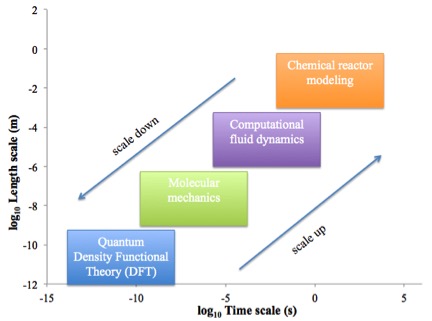
Figure 1. Length and time scales of density functional theory to chemical reactor modeling.
[1] Goodpaster, J. D.; Bell, A. T.; Head-Gordon, M. Phys. Chem. Lett. 7 (2016) 1471-1477.
[2] Gattrell, M.; Gupta, N.; Co, A. J. Electroanal. Chem. 594 (2006) 1-19.
[3] Kuhl, K. P.; Cave, E. R.; Abram, D. N.; Jaramillo, T. F. Energy Environ. Sci. 5 (2012) 7050-7059.
[4] Jorgensen, M.; Gronbeck, H. ACS Catal. 6 (2016) 6730.
[5] Jafari, M.; Zimmerman, P. M. J. Comput. Chem. 38 (2017) 645-658.
[6] Singh, M. R.; Kwon, Y.; Lum, Y.; Ager, J. W.; Bell, A. T. J. Am. Chem. Soc. 138 (2016) 13006-13012.
[7] Birdja, Y. Y.; Koper, M. T. M. J. Am. Chem. Soc. 139 (2017) 2030-2040.
[8] Tinsley Oden, J.; Prudhomme, S.; Romkes, A.; Bauman. P. T. SIAM J. Sci. Comput. 28 (2006) 2359-2389.
See more of this Group/Topical: Meet the Faculty Candidate Poster Session - Sponsored by the Education Division