
During coal mining, about 0.5 tonnes of water are consumed to produce 1-2 tonnes of coal, the coal chemical industry in China is facing a severe water shortage problem. Zero liquid discharge is required with the stricter regulations for wastewater discharge. Comparing with the other membrane concentrating techniques such as forward osmosis, disc tube reverse osmosis, membrane distilliation, electrodialysis (ED) with ion exchange membranes are considered as a promising technology for salt concentrating for a moderate salinity concentration. Matching between cation and anion exchange membrane is especially important in ED for salt concentrating. Results in this study indicate that cation exchange membrane has a greater significance for the ED concentrating performance compared with anion exchange membrane. A three-stage ED is also developed for salt concentrating (Figure 1). It is estimated that Na+ and Cl- ions carry about 9 hydrated water ions at high salt concentration, comparing with about 15-18 molecules at low salt concentration. It is feasible to concentrate the salt to a concentration higher than 20wt% with a three-stage ED. The energy consumption can be as low as 4.9-12.1 kWh/m3. It is concluded that ED is a very effective technology to minimize the wastewater capacity for evaporation in the zero liquid process.
Keywords: Ion exchange membrane; electrodialysis, zero liquid discharge, coal chemical wastewater
Acknowledgements: This research is supported by the National Natural Science Foundation of China (21676259) and National High Technology Research and Development Program 863 (No. 2015AA021001).
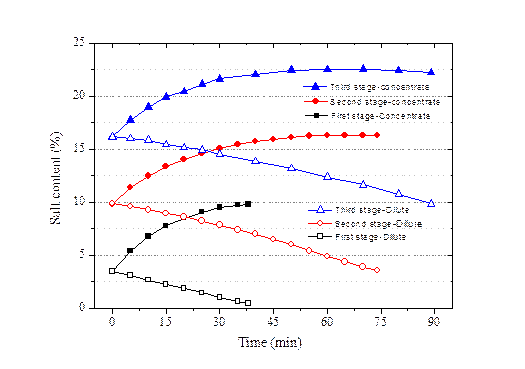 |
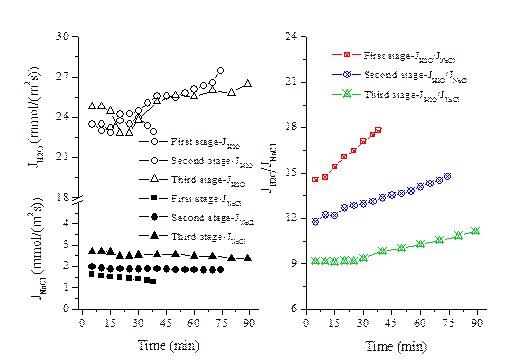
Figure 1. A three-stage electrodialysis for salt concentrating
See more of this Group/Topical: Separations Division