
Fabrication of Janus Particles
Baseemah Rucker,1,2 Zohreh Jalilvanh,1 and Ilona Kretzschmar1
1 Dept. of Chemical Engineering, City College of New York
2 Dept. of Chemical Engineering, Hampton University
Abstract
Janus particles are spherical particles that have two faces with equal surface areas and different properties. Janus particles were fabricated by semi coating monolayers of silica particles with gold. Janus particles can be coated with a variety of different materials. When a Janus particle coated with platinum is submerged in a hydrogen peroxide solution one face of the Janus particle reacts with the hydrogen peroxide solution, which propels the particle forward. The side of the particle that is coated with platinum reacts with the hydrogen peroxide and give off water and oxygen which acts as the fuel for the propulsions. The purpose of this research is to use different laboratory techniques to fabricate 4 micron semi coated Janus Particles.
Introduction
Janus particles are spherical particles with asymmetrical surface properties due to differences in the chemical compositions of their surface.1 Janus particles are named after the ancient Roman god Janus, who had two faces with one looking in the past and one looking in the future. Recently, Janus particles have gained a lot of attentions for their potential industrial applications such as use in display technology, magnetic storage, and drug delivery. Janus Particles are also used in academic research settings as molecular surfactants, building blocks of complex superstructures, chemical and biological sensors and self-motile colloidal particles.3 Recently, Janus particles have been considered as potential drug carriers because of their unique propulsion behavior.
In some solutions, Janus particles have been observed to show self-propulsion behavior owing to a region of their surface giving off a fuel resulting in a forward propulsion of the particle. This property could be very useful in many different settings, if the direction of the particle motion could be controlled. However, Brownian rotation, i.e., the tendency of a microscopic particle to rotate randomly, causes Janus particles to be propelled in random directions hampering their applicability. However, recent work has shown that interactions with walls and cracks have a guiding effect on the particles’ motion because of hydrodynamic interactions.
The purpose of this research project is to use the convective assembly technique to Fabricate Janus Particles of 4 micron silica semi coated in gold.
Results and Discussion
Close-packed monolayers of silica particles have been made using the monolayer technique describe above. To make the solution of silica particles, dry silica powder was measured out on a scale and water was added resulting in a weight fraction of 50%. The 50 wt% solution was sonicated for 30 minutes and centrifuged at 4.4 rpm for 8 minutes. Afterwards, the water above of the particles was removed and 3 drops of deionized water were added to the solution. The solution was added into the wedge and the infusion rate of the syringe pump was set to 10 mL/min. At this rate, multilayers formed. Reducing the infusion rate to 6 mL/min resulted in a mix of monolayer and multilayers. Next, the infusion rate was kept the same, but two more drops of water were added to the solution reducing the weight fraction to ~30%. At 30wt%, the submonolayers were formed with particles broadly disperse on the substrate. At this point, the infusion rate was increased to 7.5 mL/min and monolayers were successfully produced (see Figure 1).
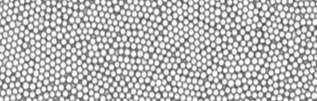
Figure 1. Close-Packed Monolayer of SiO2 particles.
Some areas of the particle layers showed non-close packing and were wiped of the silicon wafer with a cotton swab. Once cleaned, the wafers with close-packed regions were transferred to the PVD system (Figure 2).
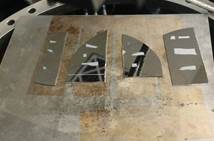
Figure 2. Close-packed Monolayer of SiO2 in PVD machine before coating
A 5 nm layer of titanium was first evaporated followed by the evaporation of 15 nm of gold yielding particles with a 50% gold coating. Both layers are rather thin and thus the gold layer appears transparent to the naked eye (see Figure 3). However, inspection of the monolayer sample under the optical microscope reveals the gold layer (see Figure 4).
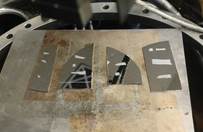
| Figure 3. Close-packed Monolayer of SiO2 in PVD machine after coating process.
|

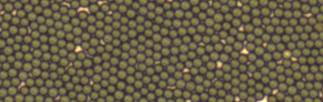
| Figure 4. Close-Packed Monolayer of SiO2 particles coated with 5 nm Ti and 15 nm Au.
|

Methods and Materials
Janus Particle Fabrication
Janus particle fabrication occurs in two steps; (i) monolayer formation and (ii) physical vapor deposition to create the cap. Closed packed monolayers are made using a syringe pump. Two glass slides are placed at an angle and one glass slide is moved using the syringe pump mechanism while the other is helps steady. A solution of particles with a specific weight percentage of particles in water is then added in the wedge between the two glass slides and the top glass slide is moved across the bottom glass slide spreading the particle solution across the silicon oxide wafer. A microscope is used to identify the regions of the silicon wafer that contain close-packed monolayers and the regions with multilayers and dispersed particles are wiped off. Close-packed monolayers are needed to prepare patchy particles, i.e., particles with less than 50% coating.
The wafers containing the close-packed monolayers are then transferred to a physical vapor deposition (PVD) system and one side of the particles will be coated with platinum at a reduced pressure of 10-4 mbar. Once coated, the Janus particles will be sonicated off the substrate and stored in solution in a glass vial.
Conclusions
Close-packed monolayers of silica particles have been made with convective assembly technique. Those particles were then sequentially coated with titanium and gold in a PVD machine making Janus particles. Next steps include the evaporation of platinum, which requires higher temperatures and the testing of the Janus particles in a 3 wt% solution of aqueous hydrogen peroxide to test if they will show propulsion behavior as a result of hydrogen peroxide decomposition. Once particle activity has been established, the substrate will be modified with polymer brushes that that arte intended to create a molecular step to direct the movements of the Janus particles. Next, the particle solution will be put on the modified silicon oxide surface in order to determine if the Janus particles in the solution are able to sense the molecular properties of the polymer brushes on the modified surface and be guided along the surface of the substrate.
Developing techniques to guide Janus particles can lead to development in drug delivery and chemical sensors.
Reference and Notes
1. Bradly, Melanie; Rowe, Joanne. The Royal Society of Chemistry 2009, 5
2. Axel H. E. Müller; Andreas Walther Royal Society of Chemistry 2008, 4
3. Okubo, Masayoshi ;Tanaka, Takuya; Okayama, Masaru; Kitayama, Yukiya; Kagawa, Yasuyuki Langmuir 2010, 26(11)
4. Vyas, Mukesh; Schneider, Konrad; Nandan, Bhau; Stamn, Manfred Royal Society of Chemistry 2008, 4, 1024-1032
See more of this Group/Topical: Student Poster Sessions