
Selective Oligomerization of Ethylene By Nitrogen Bridged Diphosphine Nickel(II) Complexes
Sivaramakrishna Akella1, Lenin Kumar V1, Varun Kaushal2 and Anubhav Mishra2
(1) Chemistry, VIT
University, Vellore, India, (2) Chemical
Engineering, VIT University, Vellore, India
Abstract
Traditional linear alpha olefin (LAO) production processes typically produce a broad and relatively inflexible distribution of linear alpha olefins. It is very important for industry to produce valuable linear alpha olefins selectively without co-producing other low-value by-products. Selective processes like production of 1-hexene and 1-octene are the targets. In this connection, numerous catalysts for ethylene trimerization to 1-hexene have been reported, and a process is now practiced commercially. Recently, the first catalysts for the selective tetramerization of ethylene to 1-octene were reported using chromium based catalysts. The active catalyst is typically generated by a combination of a chromium source with a diphosphine ligand in the presence of an aluminoxane activator. Mechanistic studies on these catalyst systems indicate that the 1-octeneis liberated from a metallcyclononane catalytic intermediate, formed by an extension of the metallacyclic mechanism previously proven for ethylene trimerization reactions. Herein, we report the catalytic ethylene oligomerization reactions to produce LAOs using phosphine based Ni complexes (Eq.1).
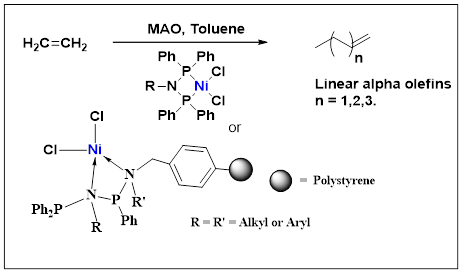
Eq.1: General scheme for ethylene oligomerization reaction
Results indicate that formation of 1-hexene and 1-octene with nickel complexes are quite feasible. Here the temperature can control the product distribution, while Pd(II) complexes prefer to yield more dimerization to 1-butene. This could be due to the better stability of nickelacycloalkanes and they will be allowed to insert further ethylene molecules. Palladacycloalaknes can undergo relatively faster β-hydride elimination to yield 1-butene. The bimetallic catalyst showed a controlled distribution of C6 and C8 products based on the reaction conditions. By fine-tuning the ligands as well as reaction conditions it is possible to achieve the selective trimerization and tetramerization. The product distribution strongly depends on the nature of remote substituent ‘R’, pressure, temperature and solvent employed.
See more of this Group/Topical: Student Poster Sessions