
The Effect of Fluorination on the Interfacial Properties of Alcohols and Carboxylic Acids
Molecular dynamic simulations are used to investigate the effect of the fluorination on surfactant-like moleculesÕ physical properties and interfacial behavior at air-water and octanol-water interfaces. The project includes comparisons between the properties of molecules such as methanol, pentanol, and octanol to their fluorinated counterparts and various C8-fluorotelomers. Interfacial tension and octanol-water partition coefficients are calculated in an effort to predict the biological and environmental impact of these molecules. Understanding the partitioning and interfacial behavior of these molecules is expected to inform the development of alternative surfactants that could, potentially, serve the same purpose with lower potential for bioaccumulation.
To date, we have collected preliminary results for the octanol-water partitioning coefficients [1] and surface tension behavior of 8-carbon fluorotelomers. The Adaptive Biasing Force (ABF) method was used to calculate the change in free energy for hydration and solvation [2-4] of the C8-fluorotelomers and the partitioning coefficient was then modeled by the equation

Ultimately, the change in free energies are calculated as the difference between the two plateaus. Values for the change in free energies and the octanol-water partition coefficients are recorded in Table 1.
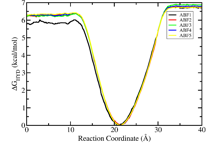
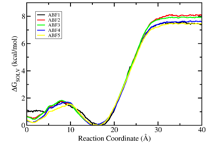

Table 1: Calculated octanol-water partition coefficients
Molecule Name |
|
|
|
Perfluoromethanol (CF3OH) | 2.375 | 1.719 | 0.999 |
Perfluorooctanol (C8F17OH) | -7.761 | -2.195 | 1.002 |
7-1FTOH (C8F15H2OH) | 6.919 | -3.230 | 0.996 |
6-2FTOH (C8F13H4OH) | 7.040 | 0.462 | 0.997 |


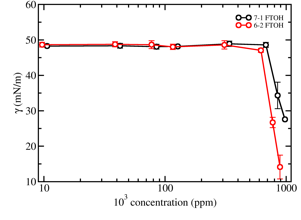
Simulations were performed in NAMD, version 2.9[5]. For the fluorotelomer surface tension
calculations, an interface 50  slab of TIP3P water
molecules, with a density of 1 g/cm3, in the center of a

 box was used[6]. Calculations were only made for TIP3P water
model at 300K. Figure 3 represents the surface tension as a function of
concentration of the fluorotelomer at the TIP3P water interface.

References:
1. Bhatnagar, N., G. Kamath, and J.J. Potoff, Prediction of 1-octanolÐwater and airÐwater partition coefficients for nitro-aromatic compounds from molecular dynamics simulations. Physical Chemistry Chemical Physics, 2013. 15(17): p. 6467-6474.
2. Darve, E. and A. Pohorille, Calculating free energies using average force. The Journal of Chemical Physics, 2001. 115(20): p. 9169-9183.
3. Darve, E., M.A. Wilson, and A. Pohorille, Calculating free energies using a scaled-force molecular dynamics algorithm. Molecular Simulation, 2002. 28(1-2): p. 113-144.
4. Rodriguez-Gomez, D., E. Darve, and A. Pohorille, Assessing the efficiency of free energy calculation methods. The Journal of chemical physics, 2004. 120(8): p. 3563-3578.
5. Phillips, J.C., et al., Scalable molecular dynamics with NAMD. Journal of computational chemistry, 2005. 26(16): p. 1781-1802.
6. Vega, C. and E. De Miguel, Surface tension of the most popular models of water by using the test-area simulation method. The Journal of chemical physics, 2007. 126(15): p. 154707.
See more of this Group/Topical: Student Poster Sessions