
Tuesday, November 17, 2020
Interfacial Phenomena (01C) (PreRecorded+)
Template-directed assembly of particles combines benefits of top-down and bottom-up nanofabrication approaches and is promising for the mass production of periodic nanostructures in a high-throughput, low-cost manner. Graphoepitaxy allows manipulation of favored particle lattices structures, and pattern density multiplication can be achieved. Here, we studied the directed assembly of hard spherical particle monolayers within square confinements, computationally and experimentally. Grand Canonical Monte Carlo simulations are used to model the adsorption process of particles onto a pre-patterned substrate and predict the equilibrium packing structures of particles in square wells of specific dimension. A mechanical rubbing process is used for the directed assembly of a monolayer of particles, dominated by hard particle contacts. Both simulations and experiments demonstrate graphoepitaxy of particle monolayers into square lattice arrangements. The precision of graphoepitaxy decreases as template density reduces. Graphoepitaxy of square lattices effectively vanishes with square templates of side length larger than five times the particle diameter. In template cells of three to five particle diameter side length, some defects appear and can disrupt the square packing structure. The two main causes are insufficient packing of particles and particle polydispersity.
This combined computational/experimental study illustrates prediction of the pattern multiplication limit and structures for the assembled particle monolayers in templates. The predictions are semi-quantitative, based on results from equilibrium statistical mechanics, even for experiments where the assembly process is nonequilibrium in nature.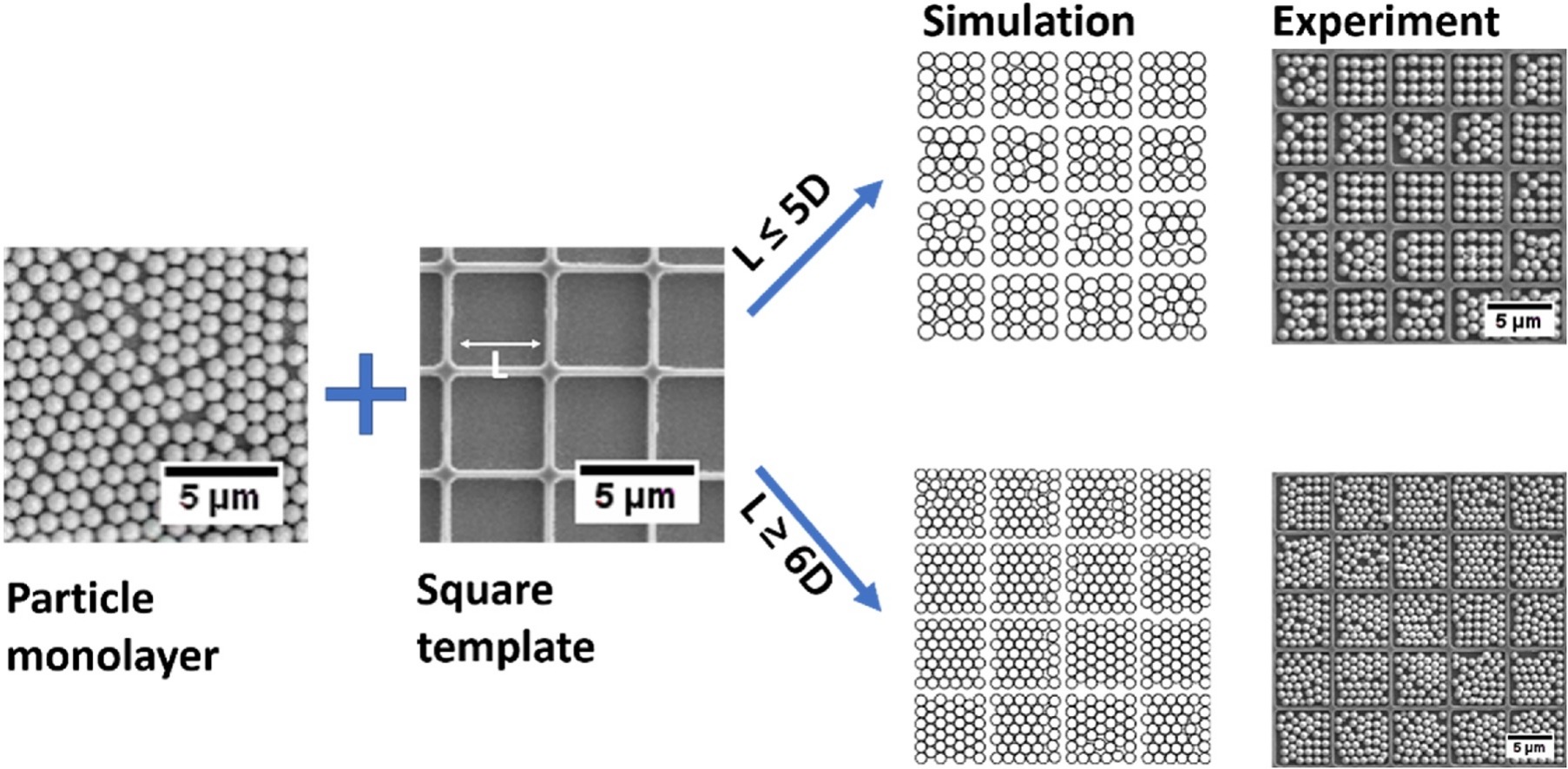
See more of this Session: Directed and Self Assembly of Colloids
See more of this Group/Topical: Engineering Sciences and Fundamentals
See more of this Group/Topical: Engineering Sciences and Fundamentals