
Monday, November 16, 2020
Fluid Mechanics (01J) (PreRecorded+)
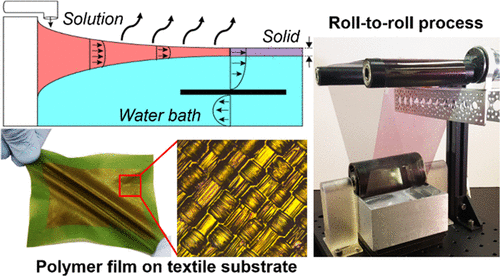
This work demonstrates that a thin polymeric film (10–80 nm) can be continuously drawn from the meniscus of a nonpolar polymer solution at an air–water–fluoropolymer interface using a roll-to-roll process: “interfacial drawing”. With this process, it is possible to control the thickness of the film by manipulating the concentration of the solution, along with the drawing velocity of the receiving substrate. We demonstrate the formation of thin films >1 m in length and 1000 cm2 in area, using our custom-designed apparatus. Interfacial drawing has three characteristics which compare favorably to other methods of forming and depositing polymeric thin films. First, the films are solidified prior to deposition, which means that they can be used to uniformly coat nonplanar, rough, or porous substrates. Second, these films can be stacked into multilayered architectures without risk of redissolving the layer beneath. Third, for some materials, the process yields films with superior mechanical compliance for applications such as wearable or flexible devices, compared to films produced by spin-coating. We demonstrate the utility of interfacial drawing by forming thin films of various semiconducting polymers, including the active layers of all-polymer bulk heterojunction solar cells as well as barrier coatings. As part of these demonstrations, we show how floating polymeric films can be transferred easily to diverse substrates, including those with rough and irregular surfaces, such as textiles and fabrics.
See more of this Session: Interfacial and Nonlinear Flows
See more of this Group/Topical: Engineering Sciences and Fundamentals
See more of this Group/Topical: Engineering Sciences and Fundamentals