
Wednesday, November 18, 2020
Materials Engineering and Sciences Division (08) (PreRecorded+)
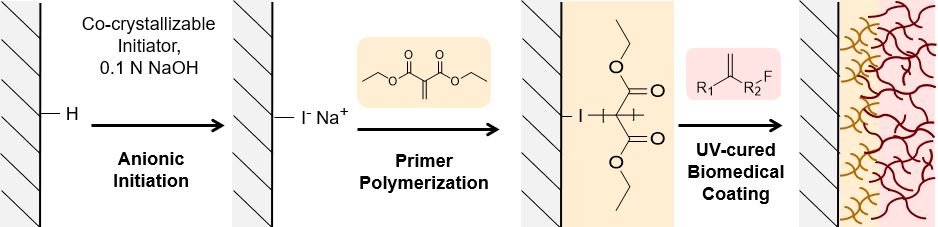
Medical devices such as catheters and joint prosthetics benefit from lubricious coatings. However, physicians and the Food and Drug Administration report biomedical coatings may leach particulates, detach from the substrate, and travel through patients' bodies to potentially cause arterial blockages (embolisms). Since most lubricious coatings are applied and cured on the surface, better adhesion and durability could be attained by covalently bonding the coating to the substrate. Surface-initiated polymerization has been used to graft thin polymer films to the surfaces of bulk polymer substrates coated with immobilized initiators. Here, we add a co-crystallizable polymer additive, poly(ethylene-co-acrylic acid), to a poly(ethylene) substrate, and after base treatment, use the carboxylate group to initiate surface polymerization of diethyl methylene malonate at ambient, atmospheric conditions. Attenuated total reflectance Fourier transform infrared spectroscopy is used to demonstrate the chemical functionalization of the surface with poly(diethyl methylene malonate). Through this approach, we propose to use methylene malonate chemistries as covalently attached anchors for biomedical coatings, which we hypothesize will promote adhesion and durability.
See more of this Session: Polymer Thin Films, Confinement, and Interfaces II
See more of this Group/Topical: Materials Engineering and Sciences Division
See more of this Group/Topical: Materials Engineering and Sciences Division