
Biodiesel, an environmentally friendly fuel can be produced through catalytic reaction of oil and renewable alcohols; however, biodiesel production generates glycerol as a by-product and is being treated as a waste. Therefore, developing a new route for glycerol conversion into high-added value products is an attractive method to utilize it for economic viability of biodiesel industries. As shown by Equations (1)-(3), various reactions, including SRG, glycerol decomposition and water gas shift,1 making the system rather complex to be selective to produce H2 can be promoted. Therefore, the aim of this work focuses on improving the catalytic activity, stability and coke-resistant Ni-based silicalite-1 catalyst by encapsulation process.
Materials and Methods
In this study, Ni-Silicalite-1 zeolite crystals were synthesized using similar approach as reported by Wang 1. The SRG experiments were carried out at 750 oC for 6 h, and samples of the product gases (H2, CO2, CO and CH4) were subsequently analyzed using gas chromatograph (GC, PerkinElmer, Clarus® 580) equipped with TCD and FID, respectively.
Results and Discussion
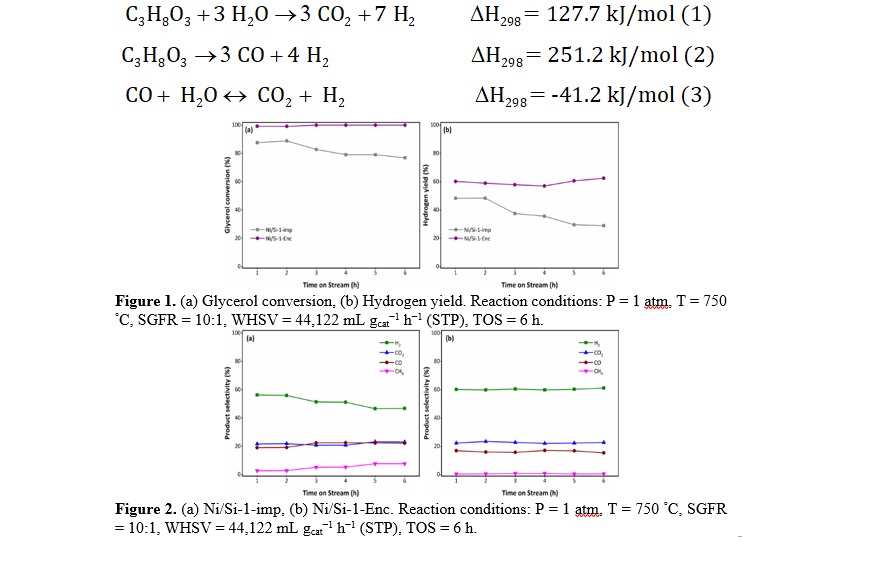
A glycerol conversion of ~ 99% was achieved for Ni/Si-1-Encapsulated catalyst, while a lower glycerol conversion of ~85 % was obtained for Ni/Si-1-impregnated between 1 – 2 h, then it dropped to ~80% for 3-6 h as shown in Figure 1. Similarly, the selectivity of H2 (Figure 2b) was more active (~60%) and stable during the time-on-stream (TOS) as compared to Ni/Si-1-impregnated catalyst shown in Figure 2a.
Significance
The results showed that the Ni/Si-1-Encapsulated catalyst was more active and selective towards H2 production from SRG and exhibited coke resistance ability at 750 °C.
Reference
[1] Wang N, Sun Q, Bai R, Li X, Guo G, Yu J. In Situ Confinement of Ultrasmall Pd Clusters within Nanosized Silicalite-1 Zeolite for Highly Efficient Catalysis of Hydrogen Generation. Journal of the American Chemical Society 2016;138(24):7484-7.
See more of this Group/Topical: Fuels and Petrochemicals Division