
 Google
 Yelp
 Facebook
 Twitter
 ChEnected
438807 Genome-Scale Metabolic Network Reconstruction for P. Stutzeri A1501 and Experimental Validation
Pseudomonas stutzeri is a gram-negative bacterium capable of living in a wide spectrum of natural environments and occupying diverse ecological niches. Many metabolic capabilities such as denitrification , degradation of aromatic compounds, biosynthesis of polyhydroxybutyrate and nitrogen fixation have been identified in different strains of this species. Strain A1501 of P. stutzeri has been isolated from rice rhizosphere and can provide this plant with fixed nitrogen and phytohormones. These interesting features encouraged us to study its metabolism at the systems level. A typical systems biology framework for analyzing cell metabolism is the constraint-based modeling. This framework involves the application of stoichiometric and reversibility constraints on reactions. The metabolism is summarized in a matrix in which the rows represent the metabolites and the columns represent the reactions and the elements are the stoichiometric coefficients of the corresponding metabolites in their related reactions. A linear objective function, representing the cellular growth, is optimized under steady-state assumption and the metabolic fluxes are defined.
In this work, we present the first genome-scale metabolic model (iPB890) for P. stutzeri A1501, containing 890 genes, 1134 reactions, and 813 metabolites. A combination of automatic and manual approaches was used for the reconstruction process. The draft network was constructed using RAVEN toolbox. This toolbox is able to use previously-published models as templates. The draft metabolic network model was generated by considering P. aeruginosa and P. putida metabolic networks as templates. The process is schematically depicted in Figure 1. These organism-specific models are reliable sources of information since they have previously undergone manual refinements during the process of reconstruction and validation against different databases, literature and experimental data. Template-based model reconstruction is particularly useful when the template organism(s) and the organism of interest are phylogenetically close because many metabolic reactions are shared between them. Briefly, in the first stage, a bi-directional BLAST is run using protein FASTA files of the template organism(s) and the organism of interest. In the second stage of reconstruction, refinement of the draft model is done in an iterative process. The refinement is continued to a point that the model is able to carry flux through its biomass producing reaction. In the second stage, we used COBRA toolbox in order to detect gaps in the draft network and then biochemical reactions in order to fill the gaps. The model was evaluated using different experimental data sets such as specific growth rate, Biolog substrate oxidation data and other experimental observations found in the literature. In most of the evaluation cases, the model was able to correctly predict cellular phenotypes. Therefore, iPB890 can serve as a platform to explore the metabolism of P. stutzeri more thoroughly and as a tool for designing directed experiments.
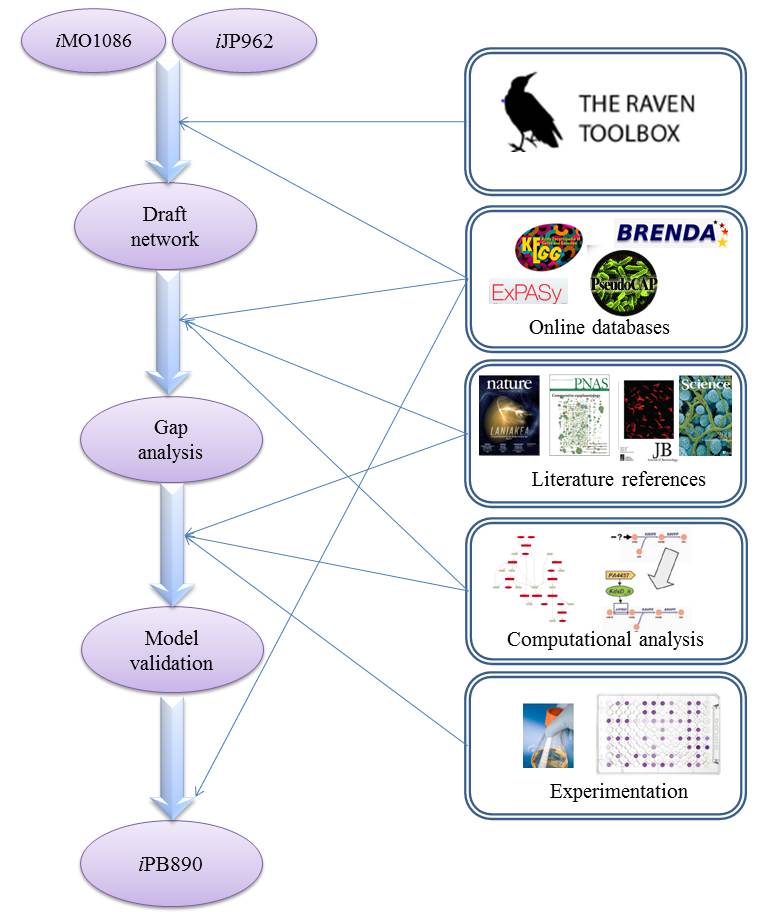
Figure 1. Schematic representation of the reconstruction process used for the metabolic network model of Pseudomonas stutzeri A1501.