
The current challenge in the treatment of autoimmune diseases is the development of therapies that induce antigen-specific immunological tolerance, which would in turn circumvent the present need for generalized immunosuppression that results in increased susceptibilities to potentially life-threatening infections and the development of neoplasia [1].
We had previously shown that antigen (Ag) coupled to apoptotic splenocytes was capable of inducing Ag-specific immunological tolerance that ultimately resulted in the prevention and treatment of both relapsing-remitting experimental autoimmune encephalomyelitis (R-EAE) [2] and allergic airway inflammation (AAI) [3]. This approach is the focus of a Phase I/IIa clinical trial examining the effects of immunological tolerance using multiple myelin peptides coupled to autologous peripheral blood leukocytes in early relapsing-remitting multiple sclerosis (MS) patients.
In order to facilitate translation into the clinic and to more elegantly and precisely probe the mechanisms of tolerance induction, we have engineered a robust multi-functional nanoparticulate platform for the delivery of Ag in a fashion that induces Ag-specific immunological tolerance in the R-EAE SJL/J mouse model of MS and the ovalbumin (OVA)-induced AAI BALB/c mouse model of allergic asthma.
 We
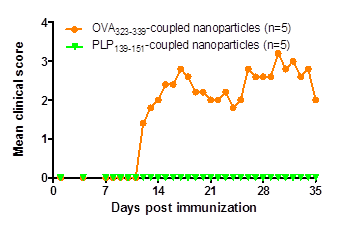
have shown that synthetic nanoparticles coupled with the myelin epitope PLP139-151
were capable of completely preventing and treating R-EAE. Therapy was initiated
either before the induction of disease or at peak disease severity during the
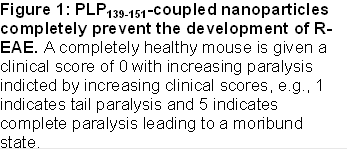
acute onset of disease (Figure 1). In particular, PLP139-151-coupled
nanoparticles inhibit the development and prevent the relapse of R-EAE more
effectively than PLP139-151-coupled apoptotic splenocytes. Similarly,
we have shown that synthetic nanoparticles coupled with OVA were capable of
preventing AAI as efficaciously as apoptotic splenocytes coupled with OVA. Finally,
we have determined that Ag-coupled fluorescent nanoparticles localize to the
marginal zones within the spleen, an organ critical for the induction of
immunological tolerance. Progress on understanding the mechanisms leading to
the induction of immunological tolerance will also be discussed.
We envision that our multi-functional nanoparticles will provide a robust off-the-shelf Ag delivery platform for the induction of Ag-specific immunological tolerance, thus enabling the facile treatment of autoimmune diseases and allergies, with minimal side-effects. In addition, our nanoparticulate platform can be easily functionalized with various immunogenic and tolerogenic signals to allow for the intricate interrogation of the mechanisms underlying the induction of Ag-specific immunologic tolerance.
References
[1] Kohm, A.P.; Turley, D.M.; Miller, S.D. International reviews of immunology. 2005, 24, 361.
[2] Kennedy, M.K.,; Tan, L.J.; Dal Canto, M.C.; Miller, S.D. Journal of immunology. 1990, 145, 117.
[3] Smarr, C.B.; Hsu, C.L.; Byrne, A.J.; Miller, S.D.; Bryce, P.J. Journal of immunology. 2011, 187, 5090.
See more of this Group/Topical: 6th International Conference on Bioengineering and Nanotechnology