
Stabilization of Proteins by Nanoencapsulation in Sugar-Glass for Drug Delivery and Tissue Engineering Applications
Jyotsnendu Giri, Marcus T Cicerone.
Introduction: There is a need in regenerative medicine to develop next generation 'smart scaffolds' that will mimic extracellular matrix (ECM) in providing appropriate physical and chemical environmental cues for cell growth and differentiation. Such scaffolds will incorporate cytokines to direct cell behaviour. Proteins and other biomolecules sequestered in and delivered from polymeric tissue scaffolds and other delivery vehicles undergo several process and storage-related stresses throughout the life of the product that can result in significant degradation, loss of bioactivity and elevated safety risk. The stresses include exposure to hydrophobic surface (polymer and organic solvents), mechanical agitation, and elevated temperature etc1. A number of approaches have been developed to ameliorate the impact of individual processing stresses, but no single approach has been available heretofore which would protect against all these stresses. Far from meeting this ideal, many approaches for improving one aspect of performance are neutral or deleterious to others2.
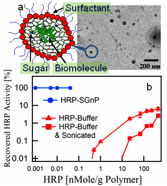
We have developed a novel Sugar-Glass-nanoparticle (SGnP) system to stabilizing proteins that is nearly ideal in that the single approach yields excellent protection from process-related stresses, very good encapsulation efficiency and storage stability, as well as giving burst-free sustained release for essentially any protein and polymer system. Figure 1a gives a schematic and transmission electron microscopy (TEM) image of the nanoparticles.
Method: We have encapsulated several model proteins, including enzymes (horseradish peroxidase (HRP) and lipase) and cytokines (insulin and BMP-2) into SGnP by flash-freezing a stable inverse micelle suspension in which the aqueous phase contains protein and sugar. After flash-freezing, the suspension is freeze-dried, leaving a small number of protein molecules embedded in each SGnP. These particles are then suspended in an organic solvent-based polymer solution, from which tissue scaffolds were fabricated by electrospinning, or gas foaming. We evaluated the performance of the SGnPs with respect to protection of proteins against process stresses in a range of polymer and solvent systems, protein distribution into the scaffold, temporal protein release profile, and storage stability up to 150 days in the scaffold. We compared performance of the SGnPs with results from a parallel study using a conventional water-in-oil emulsion (w-o) process, typical of processes commonly used for protein encapsulation in tissue engineering and drug delivery3. Enzymatic activity assay and bioactivity assay were performed for enzymes and cytokines respectively to determine activity of proteins (solvent treated/scaffold encapsulated/after released). ELISA was used to quantify the protein mass release profile.
| Figure 1. (a) Schematic and TEM of SGnP system. (b) SGnP effectiveness on protecting biomolecules from process stresses compared to conventional method. |
 Result
and discussion: Figure 1b shows that HRP protein when
encapsulated into SGnP system yields 104-fold
better post-encapsulation recovery of proteins activity after incubation into
poly-caprolactone (PCL) +chloroform solution compared
to a common approach where HRP is added from buffer. Results for the protective
performance of the SGnPs with respect to
process-related stresses shows that the SGnP system provide
excellent protection from array of non-aqueous solvents, showing essentially no
activity loss after exposure to solvents with polarity index ² 5, as compared
to > 90% loss (and up to 99.97% loss) using emulsion methods commonly in
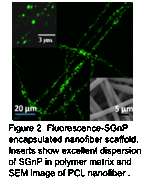
use. The SGnP system also provides excellent
dispersion of encapsulated protein (figure 2 and insert) and consequently
excellent sustained release profiles (30% during 30 days) without significant
burst release (only 8 to 11 % release on day 1) from nanofiber
or gas-foamed scaffolds made of PCL. This system also offers excellent
encapsulation efficiency (Å 100%) of the protein incorporated into the polymer
scaffold, with only minor activity loss (< 5%) at the encapsulation step. We
show also that the SGnP system provides excellent
storage stability for proteins encapsulated in a tissue scaffold. In a 150-day
storage experiment we found > 10-fold better stability SGnP-encapsulated
proteins as compared to emulsion-encapsulated proteins.
Conclusion: We have developed a simple and novel nanotechnology-based method for protectively encapsulating biomacromolecules for applications such as drug delivery and tissue engineering. Our approach is quite general, and can be used with little or no modification for essentially any water-soluble molecules. This SGnP system provides an ideal platform to prepare next generation 'smart scaffold' of any polymer system that is soluble in solvents with PI ²5.
Reference: [1] K. Fu, A. M. Klibanov, R. Langer, Nat. Biotechnol. 18, 24. 2000. [2] C. Perez, at el, Journal of Pharmacy and Pharmacology 54, 301. 2002. [3] J. C. Sy, A. S. Klemm, V. P. Shastri, Advanced Materials 21, 1814, 2009.
See more of this Group/Topical: 6th International Conference on Bioengineering and Nanotechnology