The House of Integrity: Modern Asset
Integrity ManagementAlejandro Torres-Echeverria
– Senior ConsultantRisktec Solutions, Inc.15810 Park ten Place, Suite 100Houston, TX 77084, USAPhone: +1 281-333-5080; email: Alejandro.Torres@risktec.comSteven Saunders – Principal
ConsultantRisktec Solutions, LtdOffice 3006, Liwa Heights, Jumeirah Towers, PO Box 450113Dubai, United Arab EmiratesPhone: +971 4-556-2900; email: Steven.Saunders@risktec.comAbstractAsset Integrity Management (AIM) is a widely known and well-defined
process that, if applied in the correct way, can offer asset owners and
operators the ability to manage risk and assure the integrity of assets
throughout their life cycle. The
purpose of AIM is for an organization to be able to assert, with confidence and
based on the evidence, that their assets are safe and reliable.
The foundation required to
build a robust approach to AIM starts with using recognized international
standards. PAS 55:2008, now the ISO
55000 series of standards (ISO, 2014), sets out good practice requirements for
managing physical assets and ensures that consistent terminology is applied. From this foundation an AIM “house” can be
built. This paper discusses a model called the “Asset Integrity Management
House”, which integrates under one roof all the required disciplines and
activities (which so often suffer from a “silo mentality” within an
organization) to implement full Asset Integrity Management. This model is
illustrated in Figure 1.
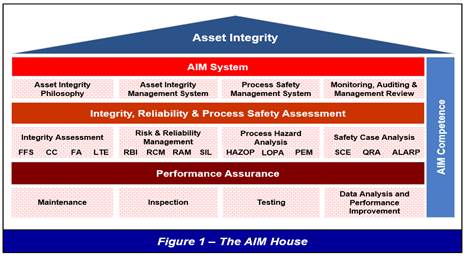
The model sub-divides into
three floors:1. AIM system. The top floor comprises the system of
policies, standards, procedures and resources needed to be in place to deliver
integrity over the whole life cycle
of an asset. There is a strong overlap
with the process safety management system which aims to prevent major process
incidents. The AIM system should be
based on the Plan-Do-Check-Act (PDCA) continuous improvement process, with
monitoring of performance, auditing of compliance and management review of
continued effectiveness.2. Integrity, reliability and process safety assessment. The
middle floor is about conducting the relevant integrity, risk, reliability,
process hazards and safety case analyses to ensure that integrity risks are
understood, the asset is designed and operated to achieve its performance
targets, and safety risks are as low as reasonably practicable. This is
populated with established methods and techniques, such as Corrosion Control
(CC), Risk Based Inspection (RBI), Hazard and Operability Analysis (HAZOP),
etc.3. Maintenance, inspection and testing. At
the ground floor level is the maintenance, inspection and testing of structures
and equipment during operations, which maintain the design intent through
life. Analysis of the results of these
activities should be used to identify timely potential developing issues and opportunities
for performance improvement.Spanning all floors is the competence of personnel in performing
their tasks to the required standards.
The benefits of such an encompassing simplified model is that
each of the different disciplines involved can identify the contribution they
are making, and align their processes and work towards achieving a common
goal. For example, some organisations
have already brought together their major risk and integrity management groups
into one single department. Another
example is the use of performance standards for safety and environmentally
critical equipment (SCE) to provide the bridge between the claims in a safety
case and the actual on-site maintenance, inspection and testing activities.Asset
integrity management is not just about extracting as much life out of an asset
as possible; it is about ensuring consistent and safe performance of the asset,
throughout its life, to deliver business objectives profitably and without
major incidents. These goals can be
realized following the Asset Integrity Management House model. References
ISO (2014). ISO 55000:2014,
Asset management -- Overview, principles and terminology. International
Organization for Standardization. Geneva, Switzerland.KeywordsAsset integrity, integrity management, process safety
management, reliability, maintenance, inspection.

