
Surface characterization and evaluation of biofilm growth on reverse osmosis membranes functionalized with bio-active peptides
Marina-Yamit Lutskiy1, Shani Avneri1, Roza Fainshtein1, Sophia Belfer1, Zeev Ronen2, Roni Kasher1
1Department of Desalination & Water Treatment and 2Department of Hydrology & Environmental Microbiology, Zuckerberg Institute for Water Research, The Blaustein Institutes for Desert Research, Ben-Gurion University of the Negev, Sde Boker 84990, Israel
A major problem in reverse osmosis (RO) and nanofiltration (NF) technologies is fouling, and the most rigorous type of fouling is biofouling. In our recent study we have developed a novel approach to control biofouling of RO membranes which is based on multivalent linking of antimicrobial peptides (AMPs) to the membrane surface and inhibition of biofilm formation (Fig 1).
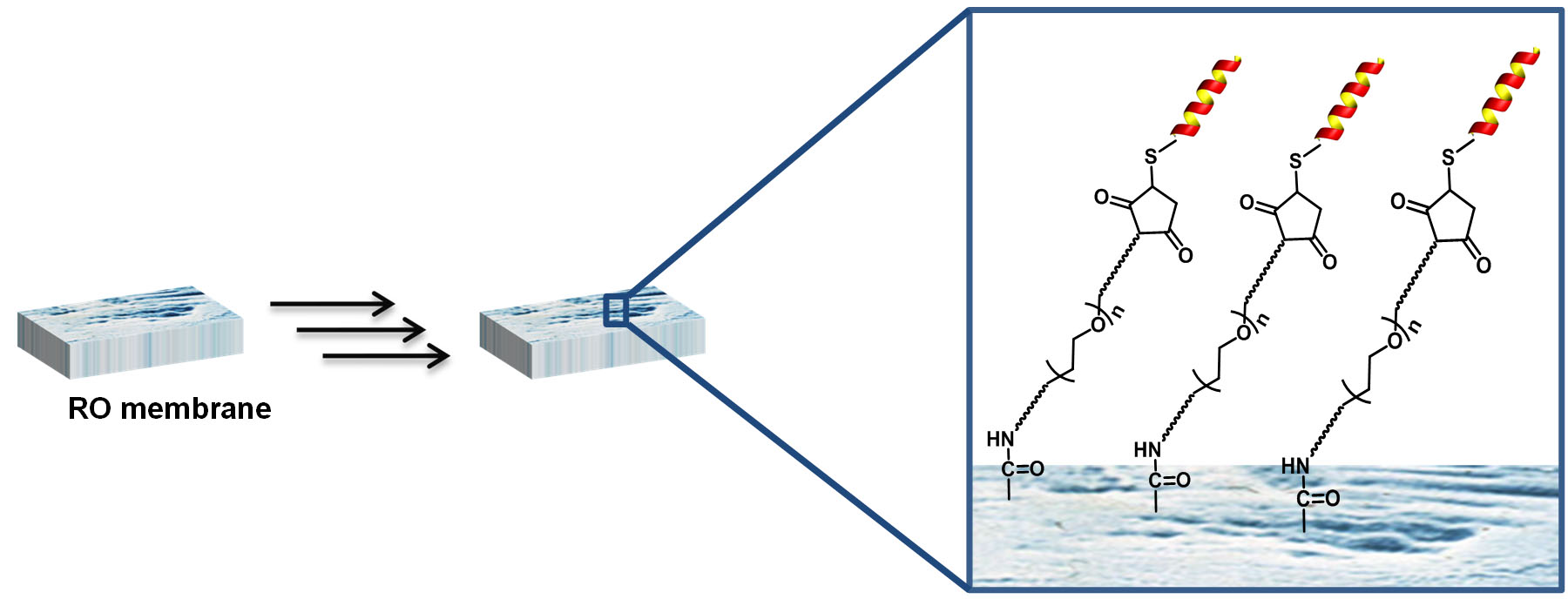
Figure 1: Schematic illustration of bio-active peptides immobilized onto RO membranes through maleimide-thiol chemistry.
Here we present a thorough physico-chemical characterization of RO membranes modified with AMPs, as well as the three-step procedure used for immobilization. Infrared spectroscopy, an invaluable tool in organic structure determination, was used primarily to assess the chemical structure of immobilized membranes.
However, analytical difficulties to observe amide bonds of the peptides by ATR-IR were encountered due to peak overlap with the existing amide bonds of the aromatic polyamide membrane. Hence, instead of using polyamide membrane, the same chemical procedure was performed on polyacrylonitrile (PAN) membrane which does not contain amide bonds. Using PAN membrane, each step of the immobilization could be assessed by IR spectroscopy (Fig 2). Measurements of the water droplet contact angle revealed changes in the surface wettability upon completion of each immobilization step.
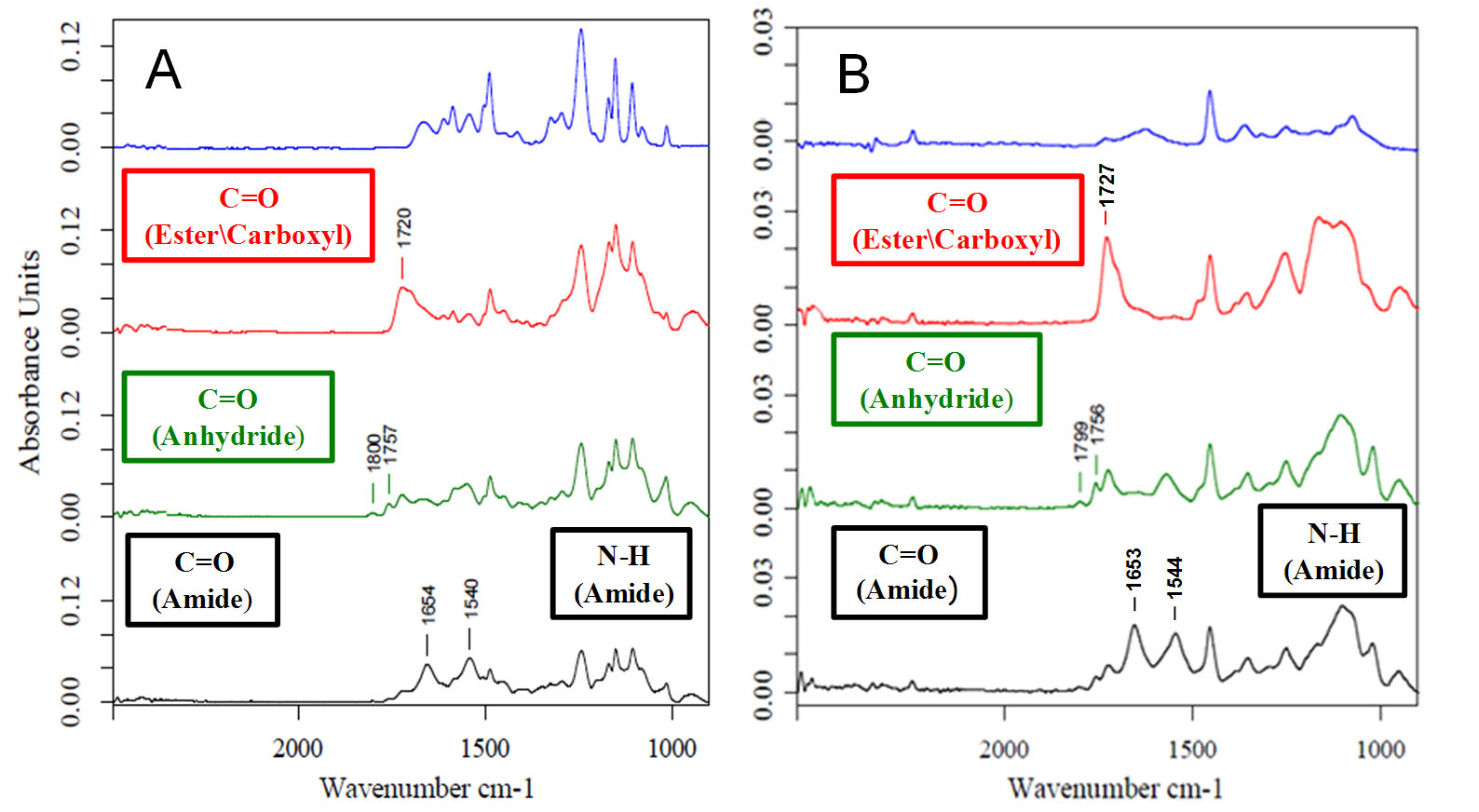
Figure 2: ATR-FTIR spectra of (A) polyamide membrane and (B) polyacrylonitrile membranes (blue), and their surfaces modification by graft polymerization (red), graft+Jeffamine (green) and graft+Jeffamine+MI+all-(D)-Modelin-1 (black).
For quantitatively evaluating the anti-biofilm effects of immobilized AMPs, a new method was developed and is described herein. The method is based on incubation of the RO membranes with suspended bacteria, followed by sequential incubations in sterile growth media, plating, and colony count. The results showed that RO membranes functionalized with bio-active peptides were less susceptible for biofilm growth than unmodified RO membranes. Hence, immobilized peptides were successful in inhibiting biofilm growth.
Peptide loading on RO membranes was determined by immobilization of 7-amino-4-methylcoumarin-fluorogenic peptide, followed by detachment and fluorimetric detection. Results of such an analysis will be presented as well.
The AMPs immobilization on RO membranes may reduce biofouling of RO and NF polyamide membranes, thereby increasing the efficiency of seawater desalination and decreasing its costs and environmental impact.