Membrane distillation: hollow fiber module design and CFD modeling
Xing Yang, Hui Yu, Rong Wang, Anthony G. Fane
Summary Membrane distillation (MD), which involves mass- and
heat-transfer phenomena, is a promising technique for desalination. There are
two main challenges for its practical applications, namely the availability of
highly permeable membranes and suitable modules with improved hydrodynamics. Hence,
this study focuses on: (1) designing novel configurations and accessing module
performance for an enhanced MD process in terms of flow distribution,
temperature-polarization (TP) effect and mass flux; and (2) computational fluid
dynamics (CFD) modeling to analyze the heat-transfer phenomenon in a hollow
fiber module. Overall, performance metrics (e.g., heat-transfer coefficients,
temperature profiles, TP coefficients, mass flux and thermal efficiency) are
examined. The aim of this combined study is to provide a deep insight into the
heat- and mass-transfer phenomena in the direct contact MD (DCMD) process and
guide further optimization of MD operation for enhancement.
Keywords Membrane distillation, heat transfer, module design,
hydrodynamics, numerical simulation
<>1. Background
Membrane
distillation (MD) is a thermally driven process that produces high-quality pure
water by utilizing a hydrophobic microporous membrane. In spite of many
potential benefits, such as low sensitivity to salt concentration and high salt rejection, mild operating temperature and no applied pressure as well as the feasibility to utilize
low-grade heat, the MD mass flux tends to be low compared with other membrane processes [1]. Severe TP, which is attributed to poor hydrodynamics in underperforming modules, reduces the actual transmembrane temperature
difference and leads to a low water flux. Relatively
low thermal efficiency due to conduction through the membrane matrix has also hindered MD commercialization [2]. In recent years, attention has been paid to the MD membrane development and energy
analysis [3]. However, there has not been a
comprehensive investigation of MD module design. Also, no prior studies
have addressed the alleviation of TP and enhancing flux by altering fiber geometries or introducing turbulence aids in a hollow fiber module. On the other hand, to reveal the attributes of a well-designed module and enhanced heat transfer, temperature
distributions on membrane
surfaces should be fully described. The CFD modelling has proved to be a valuable tool in analyzing fluid
dynamic behaviour in membrane modules [4]. It can be used to assist the process
design, determine the controlling
step in the heat-transfer process and provide
guidance for scale-up. However, to date there is very limited CFD modelling of
hollow fiber modules in the literature. Therefore,
in a practical manner, this
study attempts to develop novel hollow fiber module designs to improve module performance; while on a theoretical level, a series of CFD numerical
simulations are conducted to analyze the effects of process parameters in improving module performance.
<>2. Material
and methods
2.1. Membrane
materials In this study a
hydrophobic polyvinylidene fluoride (PVDF) hollow fiber membrane developed for MD applications was characterized
experimentally. Synthetic
seawater (i.e. 3.5 wt% sodium chloride solution) was used as feed solution and
pure water as permeate. 2.2.
DCMD experiments In the MD experimental setup, both the feed and permeate solutions were cycled through the hollow
fiber module in a countercurrent
mode. On the shell side, the feed solution (313-360K) was circulated (0-12 L°¤min-1). On the lumen side, the permeate (294-327K) was circulated (0-4 L°¤min-1). In the experiments, five novel configurations with modified
geometries were fabricated and compared with a randomly-packed module; for CFD
model verification, single fiber modules were tested. 2.3. CFD computational domain and
algorithms
A
series of 2D axial-symmetric single-fiber domains were built. The simulations
were carried out using the software Fluent 6.3, with SIMPLE (Semi-Implicit
Method for Pressure Linked Equations) algorithm for pressure-velocity coupling
and QUICK (Quadratic Upstream Interpolation for Convective Kinetics) algorithm
for discretization of the conservation equations. 3. Results
and discussion 3.1. Performance
comparison of novel hollow fiber configurations Experiments
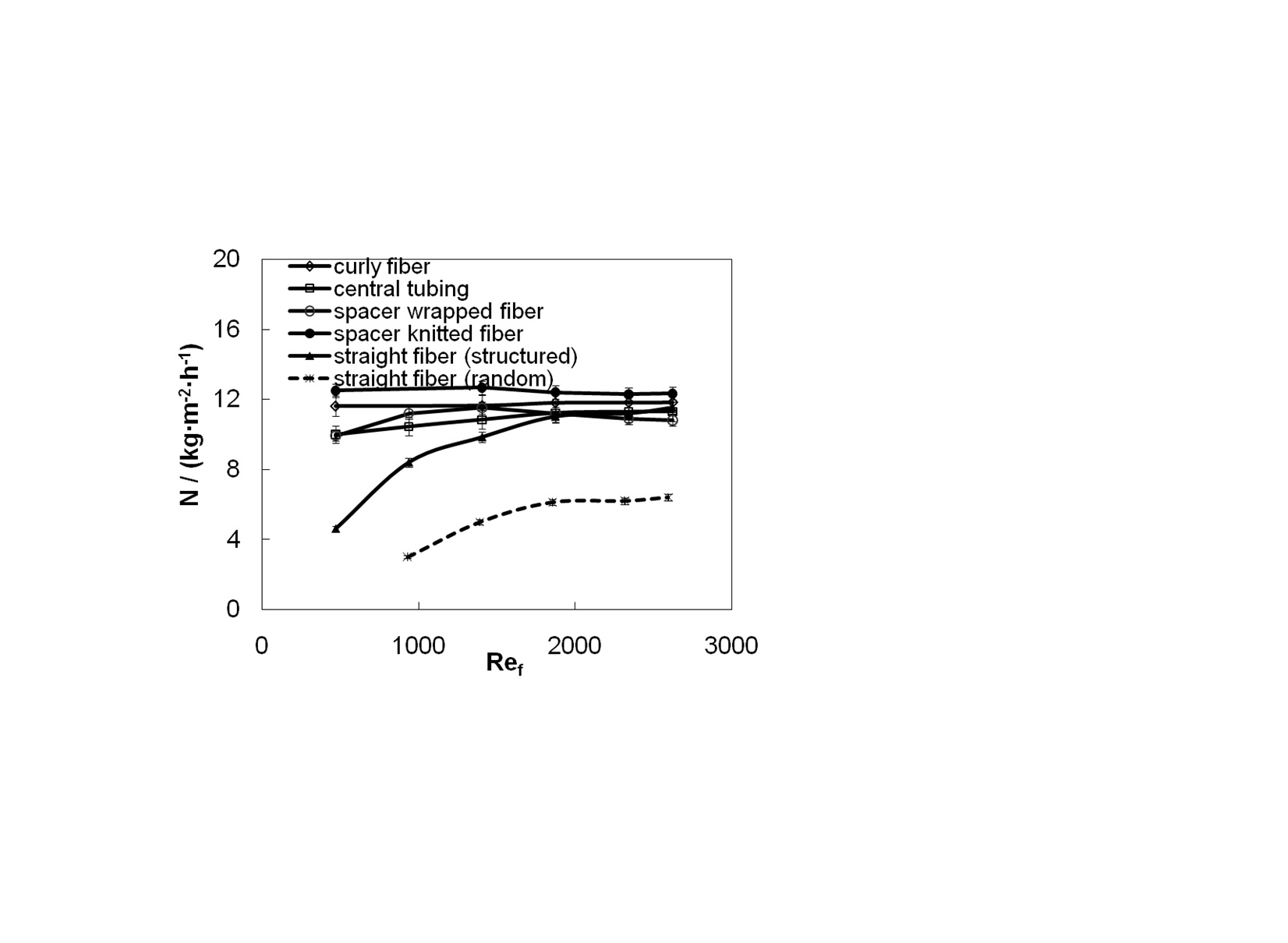
were performed to study the effects of the Reynolds number of the feed, Ref, on the fluxes in
different membrane modules. Fig. 1
shows the permeation flux as a
function of Ref for six modules. Compared to the randomly packed module, a one to three-fold flux enhancement could
be obtained even at an extremely low flow velocity in four modified
configurations. The highest flux enhancement (>300 %) was achieved by the
modules with undulating membrane surface (spacer-knitted and curly fibers). This
might be due to a more even flow distribution and the occurrence of secondary flows in the modified module that improves
the fluid dynamics and heat mass transfer. 3.2. Heat transfer analysis by
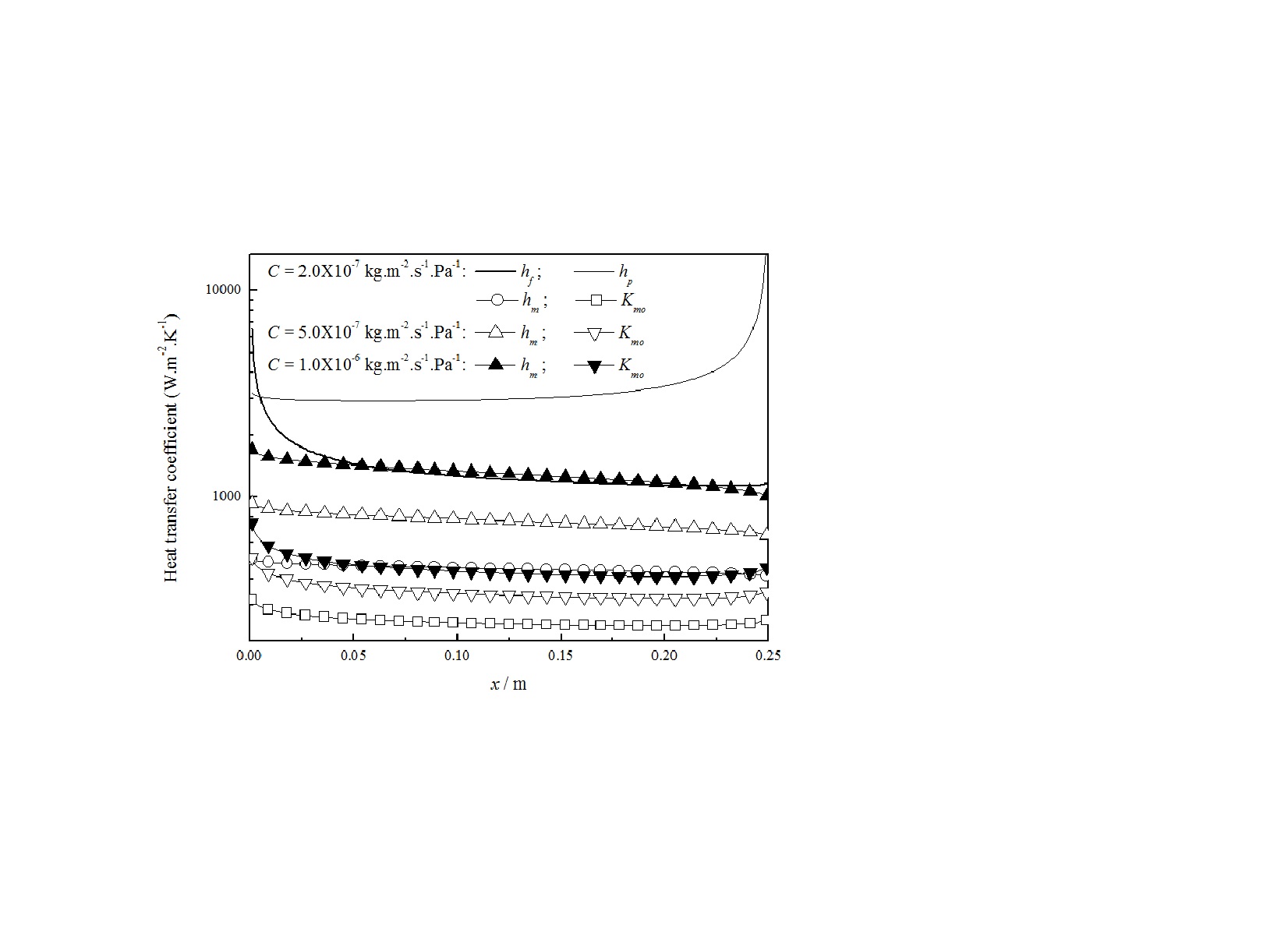
numerical simulations Fig. 2 shows the local and overall
heat-transfer coefficients for membranes with increasing MD coefficient C
as functions of fiber length. For different membranes operated under
the same hydrodynamic conditions, hm increases significantly
with increasing C. For a membrane with a low C of 2.0E-7 kg°¤m-2°¤s-1°¤Pa-1,
the heat-transfer resistance of the membrane 1/hm is
much higherthan those on the feed/permeate sides. Hence, 1/hm
is considered to play a dominant role in the heat transfer process. In this
situation, the process enhancement focus should be on the membrane instead of
the fluids. As C increases to 1.0E-6 kg°¤m-2°¤s-1°¤Pa-1,
local heat-transfer resistances of the membrane and feed flow play equally
important roles. In this case, the introduction of turbulence aids is expected
to show great effect on the heat transfer.
Fig. 1 Effect of feed velocity on permeation flux for novel designs Fig. 2 Local heat-transfer coefficients distributions for membranes with different C 4. Conclusions This work
focuses on the development of novel designs and CFD studies in hollow fiber
modules for DCMD applications. Experimentally, it was found that the improved
module performance was attributed to the altered flow geometries, which caused
effective boundary layer surface renewal and more uniform flow distribution.
Numerically, a new heat-transfer model was established and applied to analyze
the dominant effect in the MD process. Strategies for an enhanced system were
proposed. Acknowledgment Support
from Siemens Water Technology is gratefully acknowledged.
References [1] K. W. Lawson and D. R.
Lloyd, Membrane distillation, J.
Mem. Sci.,
124 (1) (1997) 1-25 [2] R. W. Schofield, A. G. Fane and C. J. D. Fell, Heat
and mass transfer in membrane distillation, J.
Mem. Sci.,
33 (3) (1987) 299-313 [3] H.
Susanto, Towards practical implementations of membrane distillation, Chem.
Eng. Process., in press (2011) [4] H. Yu, X. Yang, R. Wang and A. G. Fane, Numerical
simulation of heat and mass transfer in direct membrane distillation in a hollow fiber module
with laminar flow, J. Mem.
Sci., 384 (1-2) (2011) 107-116