
Structural control and Chemical Functionalization of Dual-layer Nanofiltration Hollow Fiber Membranes for Efficient Waste Water Treatment
Shi-Peng Sun1,Sui Yung Chan2, Tai-Shung Chung1*
1Department of Chemical & Biomolecular Engineering, 2Department of Pharmacy National University of Singapore, 4 Engineering Drive 4, Singapore 117576
Corresponding email: chencts@nus.edu.sg
In order to fabricate new generation nanofiltration (NF) membranes with high flux and high rejection, not only the structure control of the membrane substrate but also the functionalization of the selective layer needs to be taken into consideration. In this presentation, we will report our recent developments on fabricating dual-layer hollow fiber membranes for nanofiltration applications.
The first part of the presentation is the morphological evolution of a highly water permeable dual-layer NF hollow fiber membrane fabricated by the simultaneous co-extrusion of Torlon® polyamide-imide (PAI) and cellulose acetate (CA) polymer solutions through a triple-orifice spinneret in a dry-jet wet phase inversion process. As compared to conventional membranes, the dual-layer hollow fiber membranes developed here have a unique structure which consists of (1) controllable thin selective outer layer; (2) innovatively designed interface, which is finely connected between outer and inner layers, does not contribute significant transport resistance while still maintains good mechanical strength; (3) fully porous substructure with reduced transport resistance (see Figure 1).
The nanopores of dual-layer hollow fiber membranes were molecularly designed by controlling the phase inversion process with the aid of various non-solvent additives into the polymer solutions. We found that the selection of non-solvent additives has a significant impact on pore size and water permeability of the resultant NF membranes. The newly developed NF dual-layer hollow fiber membrane with methanol as additive has a relatively high pure water permeability of 11.93 l m-2bar-1h-1 with a mean effective pore radius of 0.63 nm and a more than 96.5% rejection of Na2SO4.
In the second part, we will present our latest progress on the development of a unique double repulsive NF hollow fiber membrane through interfacial polymerization of hyperbranched polyethyleneimine (HPEI) and isophthaloyl chloride (IPC). Unlike most thin film composite hollow fiber membranes of which the selective layer is on the inner surface of the fibers, the new NF membrane possesses a negatively charged substrate and a positively charged selective layer on the outer surface of the hollow fiber. The membrane has a mean effective pore radius of 0.36 nm, molecular weight cut off of 500 Da, and pure water permeability of 4.9 lm-2bar-1h-1. Due to this double-repulsion effect, together with the steric-hindrance and the solute electro-neutrality effects, the newly developed NF membrane shows superior rejections (over 99%) for both positively and negatively charged dye molecules (see Figure 2). By adjusting the pH of cephalexin aqueous solution to modify the ionization states of this zwitterionic molecule, the NF membrane shows high rejections over a wide pH range.
The HPEI modified NF hollow fiber membrane also shows very promising results in removing industrial dye molecules from water. As shown in Figure 3, the dark color of the dye solution, from a textile factory, is totally removed after treating with the NF hollow fiber membranes. The novel NF hollow fiber membranes may have great potential for sustainable manufacture applications, especially wastewater treatments in various industries.
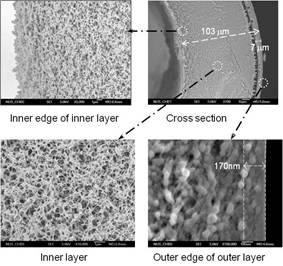
Figure 1 Cross section images of the dual-layer hollow fiber membranes.
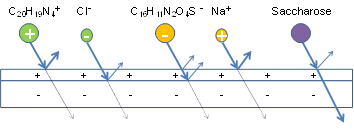
Figure 2. A schematic diagram showing the solute transport through the double repulsive interfacial polymerized NF membranes.
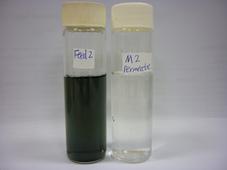
Figure 3. Comparison of the original (feed, left) dye solution and the water (permeate, right) recycled by the inventive hollow fiber membranes.