High-Flux Reverse Osmosis Membranes Incorporated with Hydrophilic Additives for Brackish Water Desalination
Lin Zhao, C.-Y. Chang, and W.S. Winston Ho, The Ohio State University
Reverse Osmosis (RO) is currently the most effective technology for water desalination, which provides an important solution to the worldwide water crisis. The most successful RO membrane in industry has been prepared via the interfacial polymerization of m-phenylenediamine (MPD) and trimesoyl chloride (TMC). However, the hydrophilicity of this aromatic polyamide (PA) thin-film-composite (TFC) membrane is insufficient, which results in a considerably limited water flux.
A hydrophilic additive is defined as a chemical compound having at least one hydrophilic portion and one reactive portion which can react with either MPD or TMC during the interfacial polymerization. It is believed that the hydrophilic additive incorporated in the TFC membrane can provide an additional pathway for the molecular transport of water. Therefore, the incorporation of various hydrophilic additives is able to improve the water flux of the RO membranes, thereby increasing the water productivity.
In this work, four kinds of hydrophilic additives, o-aminobenzoic acid/triethylamine salt, m-aminobenzoic acid/tiethylamine salt, 2-(2-hydroxyethyl) pyridine, and 4-(2-hydroxyethyl) morpholine, were investigated for their effects on membrane desalination performance for the first time. Moreover, different post-treatment approaches were applied to further improve the water flux of the synthesized membranes. All the membrane samples were tested under conditions similar to the industrial brackish water desalination process. This work is believed to be not only a great scientific interest, but also an important technological advance towards the reduction of energy and cost for water desalination.
The high-flux RO membranes were synthesized through advanced interfacial polymerization where each of the above four hydrophilic additives was added in the aqueous MPD solution, respectively. The membrane synthesized with the hydrophilic additive exhibited significantly improved desalination performance in each case, in a side-by-side comparison with the membrane synthesized without any hydrophilic additives. After optimizing the concentration of the hydrophilic additive in the MPD solution, the water flux of the synthesized membrane was enhanced by at least 68% and the salt rejection also increased slightly. For instance, the membrane synthesized with 2.85 wt% o-aminobenzoic acid/triethylamine salt showed 36.7 gfd (gallons/ft2/day) water flux and 98.2% salt rejection. As another example, the membrane synthesized with 2.4 wt% 2-(2-hydroxyethyl) pyridine showed 40.0 gfd and 98.0% salt rejection, whereas the water flux and salt rejection of the membrane synthesized without any hydrophilic additives were only 21.6 gfd and 97.7%.
The membranes synthesized with 2.85 wt% o-aminobenzoic acid/triethylamine salt and 2.4 wt% 2-2-(2-hydroxyethyl) pyridine were selected to investigate the effects of different post-treatment approaches on membrane desalination performance. After an appropriate treatment, the water flux of the synthesized membrane was further enhanced while the salt rejection was about the same. For example, the membrane synthesized with 2.85 wt% o-aminobenzoic acid/triethylamine salt showed 40.8 gfd water flux and 99.0% salt rejection, after soaking in the aqueous solution containing 5 wt% glycerol and drying at 90oC for 10 minutes. When the aqueous solution contained 5 wt% glycerol and 6 wt% camphorsulfonic acid/triethylamine salt and the heat treatment time increased to 14 minutes at the same temperature, its water flux increased to 52.6 gfd, and the salt rejection was 98.4%.
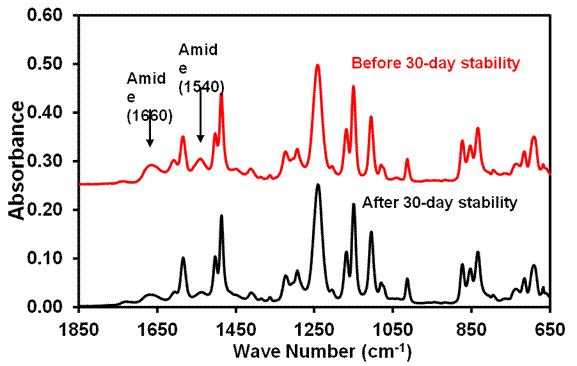
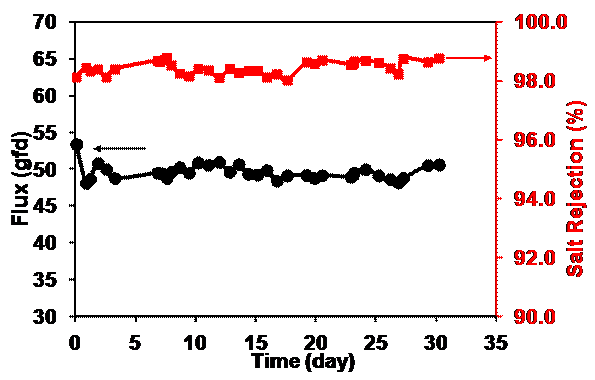
The synthesized high-flux RO membrane exhibited an excellent stability in terms of water flux (average 50 gfd) and salt rejection (average 99%) during a 30-day test with 2000 ppm NaCl solution at 25oC and 225 psig applied pressure across the membrane. This good stability was verified by comparing FTIR spectra of the same membrane sample before and after the 30-day test. These results are important for the commercialization of this high-flux RO membrane for brackish water desalination.
 |