
Abstract
Exploration of delamination in dual layer hollow fiber membranes
Laurentia Setiawan1,2, Shi Lei1, William B. Krantz1, Wang Rong1,2*
1Singapore Membrane Technology Centre, Nanyang Technological University, Singapore
2School of Civil and Environmental Engineering, Nanyang Technological University, Singapore
* rwang@ntu.edu.sg
Dual layer hollow fiber membranes have become increasingly attractive due to their many benefits made possible by one-step fabrication using the nonsolvent-induced phase-inversion method. Emerging applications of dual layer hollow fiber membranes include membrane distillation, which requires a combination of hydrophobic and hydrophilic layers, forward osmosis and facilitated transport membranes consisting of a dense selective layer and a porous support layer. In addition to the structural benefits, a dual layer hollow fiber membrane is able to reduce the cost of high performance polymers or to utilize materials having weak mechanical strength but exceptional selectivity and/or permeability by combining them with inexpensive and robust polymers as a second layer. However, the fabrication of dual layer hollow fiber membranes is a complex process in which many parameters are involved. Obtaining good lamination between the two layers is critical to casting a useable hollow fiber membrane. Interestingly, the mechanism responsible for the attachment or delamination of the two layers is not fully understood.
This study aims to explore the mechanism of the delamination phenomenon that can occur in the fabrication of dual layer hollow fiber membranes. Comprehensive experiments have been designed utilizing Torlon®, a poly(amide-imide) (PAI) polymer, as the outer layer material and polyethersulfone (PES) as the inner layer material. Simultaneous extrusion of two polymer dopes was done by using a triple orifice spinneret. Thermodynamic and kinetic properties of the polymer dope solutions and various spinning parameters were carefully tailored in order to investigate the evolution of the membrane morphology and structure.
The experimental results reveal that by altering the polymer dope chemistry and various spinning parameters, the morphology of the resultant dual layer fiber can vary from severe delamination to excellent adhesion of two layers, from a distortion of finger-like structures and an irregular inner contour to an appropriate morphology of the polymer matrix (Figure 1). A hypothesis is proposed to explain these morphological features, which is confirmed by a series of experiments. This study provides a solid foundation to develop superior dual layer hollow fiber membranes with an inter-penetrating dual layer structure.
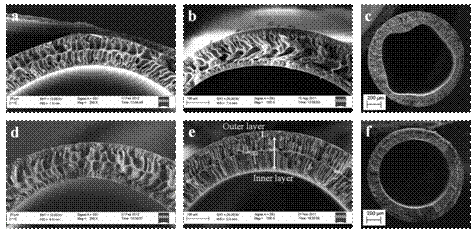
Figure 1. Cross-section morphologies of dual layer hollow fiber membranes: (a) severe delamination; (b) distortion of finger-like structures; (c) irregular inner contour; (d-e) interpenetration of macrovoids without delamination; (f) regular inner contour.