
Novel Draw Solution of Polyelectrolytes in Forward Osmosis Processes
Qingchun Ge1, Jincai Su1, Gary L. Amy2, Tai-Shung Chung1*
1Department of Chemical & Biomolecular Engineering, National University of Singapore,
4 Engineering Drive 4, Singapore 117576
2Water Desalination & Reuse Center
King Abdullah University of Science and Technology
*Corresponding author, Email: chencts@nus.edu.sg, Fax: (65)-6779 1936
Abstract
The development of the forward osmosis (FO) process has been constrained by the slow development of appropriate draw solutions. Two significant concerns related to draw solutions are the draw solute leakage and intensive-energy requirement in recycling draw solutes after the FO process. FO would be much attractive if there is no draw solute leakage and the recycle of draw solutes is easy and economic.
In this study, polyelectrolytes of a series of polyacrylic acid sodium salts (PAA-Na), were explored as draw solutes in the FO process. The characteristics of high solubility in water and flexibility in structural configuration ensure the suitability of PAA-Na as draw solutes and their relative ease in recycle through pressure-driven ultrafiltration (UF) membrane processes. The high water flux with insignificant salt leakage in the FO process and the high salt rejection in UF recycle processes reveal the superiority of PAA-Na to conventional ionic salts, such as NaCl, when comparing their FO performance via the same membranes. The repeatable performance of PAA-Na after recycle indicates the absence of any aggregation problems. The overall performance demonstrates that polyelectrolytes of PAA-Na series are promising as draw solutes, and the new concept of using polyelectrolytes as draw solutes in FO processes is applicable
Methods
The schematic diagram for the FO-UF hybrid process is depicted in Figure 1. In the FO process, PAA-Na solutions act as draw solutions to extract water through the semi-permeable FO membrane. In the UF process, the PAA-Na solutions diluted in the FO process are reconcentrated and able to reuse in the new round of FO process. Polyelectrolyte meeting the aforementioned requirements is another type of promising draw solutes in FO.
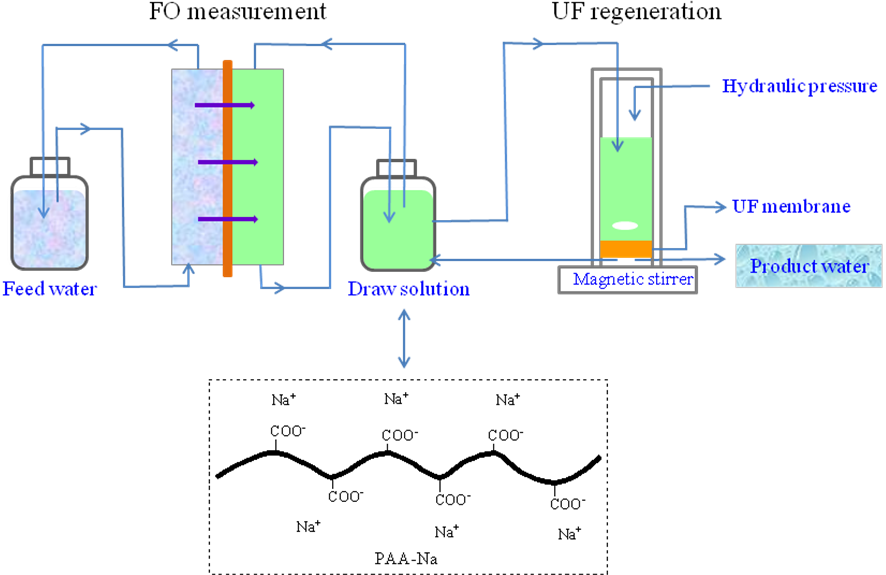
Figure 1. Schematic diagram of the lab-scale FO-UF hybrid system
See more of this Group/Topical: General Submissions