
The high water permeability and selectivity of aquaporins (water channel proteins found in biological membranes) makes aquaporin-based biomimetic membranes potentially attractive for water purification and “green-energy” production. In our previous report (Kaufman et al., Langmuir 2010) we showed that a supported lipid bilayer can be prepared on NF membrane under acidic conditions (pH 2). Herein, we show that supported biomimetic membrane can be prepared on a NF substrate under milder conditions (pH 7) by replacing previously used phospholipids with positively charged bolaamphiphiles.
The main advantage of using positively charged lipids, such as the bolaamphiphile used here, is their facile adsorption on negatively charged surfaces of NF membranes. An important parameter is the aggregate structure of the bola prior to absorption onto the membrane surface. We found that the cationic bolas tend to self-assemble into micelles, with surface of a significantly curvature as compared to larger nano-sized vesicles with an aqueous core as we studied with liposomal phospholipids. It was found that these micelles can undergo fusion on the membranes surfaces similar to vesicles, thus the lipid adhering to NF membrane surface forms a continuous supported layer. Moreover, aquaporins solubilized with micellar aggregates in solution, analogous to vesicular proteoliposomes the case of regular phospholipids, may be incorporation into the supported bolaamphiphile monolayer through a similar fusion process. To the best of our knowledge, this is the first demonstration Aquaporin-Z can be incorporated in structures with a substantial spontaneous curvature such as micelles.
The water permeability and ion rejection of the supported membranes with and without aquaporins were measured using a recently developed microfluidic NF cell. Compared with bench-scale cells, the microfluidic cell allows in situ preparation of biomimetic membranes using minimal amount of the expensive lipids and proteins and measuring their performance in cross flow conditions. Fig. 1 showing typical pristine membrane permeability reveals the following: 1) The monolayer of bolaamphiphiles effectively seals the surface of the supporting NF membranes and 2) The incorporation of aquaporinZ increases the permeability of the supported bola-amphiphile layer. These results will be discussed in detail during the talk.
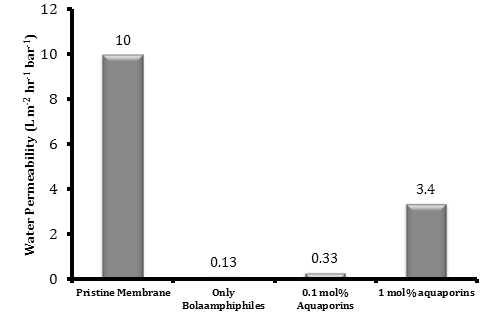
Figure 1: Water permeability of commercial NF membrane covered by bolaamphiphiles with different concentration of aquaporins
Keywords: bolaamphiphile, biomimetic membrane, microfluidic, water purification
See more of this Group/Topical: General Submissions