
Effect of Iron Electrocoagulation Pretreatment on Virus reduction during Surface Water Microfiltration
Charan Tej Tanneru1 and Shankar Chellam1, 2
1Department of Civil and Environmental Engineering, University of Houston, TX 77204-4003
2Department of Chemical and Biomolecular Engineering, University of Houston, TX 77204-4004
Abstract
Microfiltration (MF) is an excellent barrier for Giardia cysts and Cryptosporidium oocysts achieving > 99.9999% removal of these protozoa that are difficult to inactivate using free chlorine. However, viruses penetrate microfilters since they are smaller than the membrane pores. A laboratory-scale study was performed to evaluate virus reduction by a hybrid iron electrocoagulation – MF process. Overall, electrocoagulation pretreatment was ineffective for virus reduction in natural surface water achieving a maximum of only 1.5 log (97%) reduction even at high iron doses (~13 mg/L). In contrast, electrocoagulation‐microfiltration achieved 6‐log (99.9999%) virus reduction from synthetic water at 8 mg/L iron dose. In other words, electrocoagulation‐microfiltration was highly effective in controlling viruses from synthetic water that was devoid of NOM, but not with natural water that contained moderate Natural Organic Matter (NOM) concentrations (~4.5 mg/L as DOC). Direct iron speciation measurements and quantitative agreement with Faraday's law with 2-electron demonstrated electrocoagulation produces soluble ferrous iron.
Sorption of MS2 virus on to precipitated coagulant was quantified by simultaneously dissolving flocs and extracting viruses from the solid phase. Nearly all the seeded viruses were recovered from synthetic water providing direct evidence of their removal by sorption and enmeshment onto iron hydroxide flocs. In contrast, only approximately 1% of the viruses were associated with the flocs formed in natural water consistent with the measured poor removals. 1 – 2 logs of virus inactivation were also observed in the electrochemical cell for synthetic water (no NOM) but not for surface water (4.5 mg/L DOC). As ζ potential did not reach zero even when 6-log virus reductions were achieved and with increasing iron electrocoagulant dosage, sweep flocculation was the dominant destabilization mechanism and charge neutralization only played a secondary role. Importantly, virus removal from synthetic water decreased when Suwanee River Humic Acid was added. Therefore, NOM present in natural waters appears to reduce the effectiveness of iron electrocoagulation pretreatment to MF for virus control by complexing ferrous ions. This complexation inhibits (i) Fe2+ oxidation, precipitation, and virus destabilization and (ii) virus inactivation through reactive oxygen species intermediates or by direct interactions with Fe2+ ions (Tanneru and Chellam 2012).
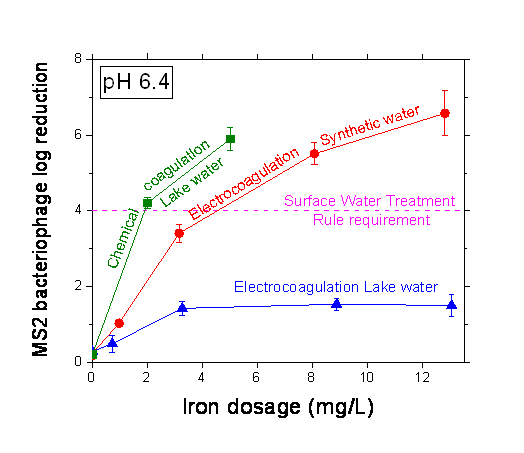
Figure 1: Comparison of virus reductions by microfiltration with different pretreatment processes and feed waters
References
Tanneru, C. T. and S. Chellam (2012). "Mechanisms of virus control during iron electrocoagulation - Microfiltration of surface water." Water Research 46(7): 2111-2120.
See more of this Group/Topical: General Submissions