
Magnetically Responsive Membrane with Attached Nanoheaters
Qian YANG1, Xianghong Qian1, S. Ranil WICKRAMASINGHE1*
1 Ralph E Martin Department of Chemical Engineering, University of Arkansas, Fayetteville 72701, USA
* ranil.wickramasinghe@uark.edu
Stimuli-responsive membranes are attractive because there is a synergy between the functions of the base membrane and the stimuli-responsive building blocks that can be utilized for smart "switchable" membrane responses.1 The most prominent example of a stimuli-responsive polymer is polyNIPAAm that exhibits a LCST at 32 °C and undergoes a conformational (swelling/deswelling) change around the LCST. By changing temperature of surroundings the polyNIPAAm chains on membrane surface or pore wall alternate between stretched and collapsed structure and subsequently leads to changes in membrane performance like flux and rejection. However, stimuli are generally exerted by means that interrupt the membrane process such as changing the temperature of the bulk feed. In this study, we established a novel method to achieved "in situ" temperature change by integration of nanoheater to the end of polyNIPAAm chains.
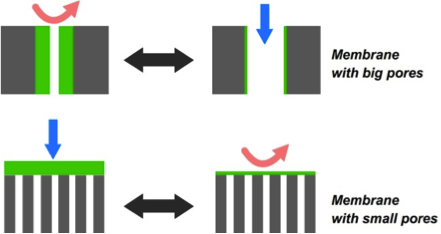
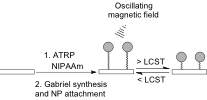
As shown in Figure 1, polyNIPAAm was grafted to membrane surfaces by surface initiated ATRP. Next, the bromine groups at the chain ends were converted into primary amine groups by Gabriel synthesis and then used for attaching superparamagnetic Fe3O4 nanoparticles covered with carboxylic groups.2 When superparamagnetic nanoparticles are subjected to an oscillating electromagnetic field, where the direction of the field changes cyclically at high frequency, dissipation of heat leads to heating of the surrounding material. The nanoparticles immobilized on polyNIPAAm chains act as a trigger for conformational change in the polyNIPAAM. Both microfiltration (MF, PET track-etched) and nanofiltration (NF, NF270) membranes were modified and showed different location of polyNIPAAm grafting (see Figure 2). For MF membranes, the polyNIPAAm layer was on the pore wall and deswelling of this layer lead to increased permeability and higher flux. On the other hand, polymer layer was formed on the top of NF270 membrane covering the pores. Therefore deswelling of the polyNIPAAm chains resulted in a dense layer on the surface and decreased permeability but increased salt rejection was observed. Such stimuli-responsive membranes could be promising in industry, especially in pharmaceutical area, for facilitated quality control and product line regulation.
References
1. Q. Yang, N. Adrus, F. Tomicki, M. Ulbricht, J. Mater. Chem. 2011, 21, 2783-2811.
2. H. H. Himstedt, Q. Yang, L. P. Dasi, X. Qian, S. R. Wickramasinghe, M. Ulbricht, Langmuir, 2011, 27, 5574-5581.
 | |||||||
 | |||||||
| |||||||
See more of this Group/Topical: General Submissions